
Music in India: a living landscape
Music in India is not a single tradition but a vast, interconnected sound world shaped by language, region, faith, community, patronage, performance and technology. It is heard in classical concerts and village gatherings, temples and shrines, festivals and family ceremonies, theatre and dance, cinema and digital platforms. Hindustani and Carnatic music developed highly refined approaches to raga, tala, composition and improvisation, while regional, folk, tribal, devotional and popular traditions preserve distinctive ways of singing, playing, remembering stories and marking important moments of life.
At a glance
A useful way to understand Indian music is to explore several layers together rather than treating one genre as representative of the whole country.
- Hindustani and Carnatic music are the two major classical systems.
- Regional, folk, tribal and community traditions connect music with place, language, livelihood, ritual, season and celebration.
- Swara, shruti, raga, tala and laya are important ideas in classical musical thought, but they are realised differently across traditions.
- Learning still depends heavily on listening, imitation, memory and sustained practice, even where notation, recordings and formal institutions are used.
- Film, light, independent and contemporary music continually interact with older repertoires, instruments and regional idioms.

Regional Music
Explore how language, geography, community, festivals and everyday life shape musical traditions across India.
Hindustani Music
Discover the North Indian classical tradition through raga, tala, composition, improvisation and major vocal and instrumental forms.
Carnatic Music
Explore the South Indian classical tradition, its composition-rich repertoire, rhythmic depth and improvisational practices.
Musical Instruments of India
Learn how string, wind, membrane and solid instruments contribute melody, rhythm, drone, resonance and tonal colour.
The building blocks: swara, shruti, raga, tala and laya
Indian classical music is often introduced through a group of interrelated ideas. Swara refers to a musical note or note-function; shruti is a subtler concept associated with audible pitch distinctions and the theoretical organisation of pitch. Raga is not simply a scale. It is a melodic framework with characteristic movements, important notes, phrases, ornaments and an identity that emerges through performance. Tala organises musical time through recurring rhythmic cycles, while laya refers broadly to tempo, pace and the flow of musical time.
- Sa functions as the tonal point of reference. Its absolute pitch can be chosen to suit a performer or instrument.
- A raga gains identity from characteristic movement and phrasing, not merely from the set of notes it permits.
- Tala is cyclical: beats are grouped into recurring patterns whose internal divisions help performers organise composition and improvisation.
- Laya may remain steady or become a field for sophisticated rhythmic development, depending on the form and performance.
- Ornamentation and continuous movement between notes are central to many styles, so the sound cannot be fully captured by a list of written pitches.
Classical traditions: Hindustani and Carnatic
Hindustani and Carnatic music share older Indian concepts of swara, raga and tala, yet they developed distinct repertoires, performance grammars, pedagogical lineages and concert conventions over many centuries. Hindustani music has historical centres across northern, western and eastern India; Carnatic music has deep historical roots in southern India. Today both are taught and performed far beyond those regional centres, within India and internationally.
| Aspect | Hindustani tradition | Carnatic tradition |
|---|---|---|
| Historical centres | Northern, western and eastern India | Southern India |
| Concert approach | Often gives extended space to gradual raga development, composition and improvisation | Often places a large composed repertoire alongside extensive melodic and rhythmic improvisation |
| Common vocal forms | Dhrupad, khayal, thumri and other forms | Varnam, kriti, ragam-tanam-pallavi and other forms |
| Frequently heard instruments | Sitar, sarod, sarangi, bansuri, shehnai, tabla, pakhawaj, tanpura | Veena, violin, flute, nadaswaram, mridangam, ghatam, kanjira, tanpura |
| Transmission | Oral lineage, individual teachers and gharana traditions alongside institutions | Oral lineage and teacher-centred learning alongside institutions and concert organisations |
The distinction is useful for orientation, but it should not be treated as a rigid border. Musicians, instruments and ideas have travelled across regions. Some areas sustain both traditions, and performers increasingly encounter each other’s repertoires through festivals, universities, recordings and collaborative work. The two systems are best understood as related but independently developed classical traditions within a much larger Indian musical environment.
Folk, tribal, regional and community music
For many people, music is first experienced through family and community rather than a concert category. Songs accompany births and weddings, sowing and harvest, journeys and work, seasonal festivals, worship, storytelling, local theatre and collective celebration. Folk and tribal traditions are not simplified versions of classical music. They possess their own aesthetics, repertoires, performance practices, instruments, social roles and systems of memory. Some are participatory and open to a whole community; others are maintained by specialised hereditary or professional performers.

- Baul traditions of Bengal bring together song, poetry, spiritual reflection and portable instruments such as the ektara and dotara.
- Bihu-associated music in Assam links song, dance and instruments with seasonal celebration, youth and agricultural life, while the wider North-East contains many distinct community traditions of its own.
- Rajasthan is known for powerful vocal and instrumental traditions maintained by communities and hereditary performers, including repertories accompanied by bowed strings, plucked strings, percussion and wind instruments.
- Kajri, chaiti, sohar, wedding songs and other seasonal or life-cycle forms across northern India connect music with monsoon, birth, marriage, local language and social memory.
- Maharashtra’s lavani and tamasha, Gujarat’s garba-related music, Himalayan song traditions, central Indian Adivasi performance traditions and the many folk forms of southern India show how closely music can be tied to dance, theatre and community gathering.
- Devotional sound worlds include bhajan, kirtan, abhang, qawwali and numerous region-specific forms linked with temples, shrines, congregations, poetry and pilgrimage.
Labels such as folk, tribal, devotional, regional and classical are useful for navigation, but living traditions often overlap. A seasonal song may also be devotional; a theatre form may contain sophisticated composed music; a folk instrument may enter a concert stage; and a melody may travel into cinema or popular music. Looking at who performs, where the music is heard, what occasion it serves and how it is transmitted often reveals more than the genre label alone.
Devotion, theatre and dance: music as part of a larger performance world
Indian music frequently exists in close relationship with poetry, movement, storytelling and sacred practice. Temple traditions, Sufi shrines, congregational singing, classical dance, folk theatre and dramatic performance all use music differently. In some settings the text and devotional message are central; in others rhythm supports dance, instrumental cues shape dramatic action, or a singer becomes the principal narrator. This interdependence is one reason the study of Indian music often leads naturally into literature, dance, theatre, ritual and regional history.
Learning the tradition: ear, memory and lineage
Oral transmission remains fundamental to Indian music. A learner listens closely, imitates, memorises, repeats and gradually absorbs phrasing, intonation, repertoire and performance judgement from a teacher. The guru-shishya relationship has historically been important in classical and many traditional arts, though learning today also takes place through universities, academies, music schools, workshops, recordings, online lessons and digital archives. These newer resources expand access, but they do not eliminate the importance of attentive listening and guided correction.
- Listening develops recognition of raga phrases, ornamentation, tone and stylistic nuance.
- Repetition turns compositions and rhythmic patterns into embodied memory rather than purely written knowledge.
- A teacher helps a learner distinguish what is technically possible from what is stylistically appropriate.
- Performance experience develops interaction with accompanists, audiences, dancers, fellow singers or the rhythmic cycle itself.
- Recordings and archives allow comparison across artists, regions and generations, making them valuable complements to live teaching.
Music on the page: notation and what it cannot show
Indian music has a long history of musical thought preserved in texts. Works associated with the Natya Shastra, Matanga’s Brihaddeshi and later musicological traditions discuss sound, pitch organisation, melodic structure, rhythm and composition. The Brihaddeshi is especially important in the history of raga and is described in the current source material as an early text associated with raga and a form of sa-ri-ga-ma notation. Modern notation systems make teaching, preservation and comparison easier, but notation remains a map rather than the complete musical territory.
| Notation approach | Illustrative ascending pattern | What it helps show |
|---|---|---|
| Basic Hindustani sargam | Sa Re Ga Ma | Pa Dha Ni Sa’ | Relative swaras and a memorable outline; practical systems add signs for altered swaras, octave, duration and rhythmic placement. |
| Bhatkhande notation | Sa Re Ga Ma | Pa Dha Ni Sa’ | A systematic written approach for swara, octave and tala placement, widely encountered in Hindustani teaching and published repertoire. |
| Paluskar notation | Sa Re Ga Ma | Pa Dha Ni Sa’ | A different set of symbols and conventions for duration and rhythmic organisation in Hindustani pedagogy. |
| Carnatic swara notation | Sa Ri Ga Ma | Pa Da Ni Sa’ | Represents swaras within compositions and tala structure; the system distinguishes pitch variants of Ri, Ga, Ma, Da and Ni. |
| Western letter reference | C D E F | G A B C | Only an orientation if Sa is provisionally set to C; it does not reproduce Indian intonation, ornamentation or raga grammar. |
The tonic Sa is movable, so Indian notation is fundamentally relational rather than tied to one compulsory concert pitch. Written symbols also struggle to capture gamaka, meend and other continuous movements between notes. Two musicians may therefore read the same skeletal notation yet produce very different results depending on tradition, teacher, raga grammar and performance style. The best use of notation is to support listening and memory, not replace them.
Instruments: families of sound
Indian instruments can be explored not only by region or genre but also by the way they produce sound. The current source material uses the traditional fourfold classification of tata, sushira, avanaddha and ghana. This framework is especially useful because it places concert instruments and many regional instruments within a common acoustic logic.
| Traditional category | How sound is produced | Examples |
|---|---|---|
| Tata vadya | Vibration of stretched strings, plucked or bowed | Sitar, sarod, veena, sarangi, santoor, tanpura |
| Sushira vadya | Air vibrating in a hollow column | Bansuri, shehnai, nadaswaram and many regional flutes or pipes |
| Avanaddha vadya | A stretched membrane is struck | Tabla, pakhawaj, mridangam, dholak, chenda and many regional drums |
| Ghana vadya | The solid body of the instrument itself vibrates | Manjira, kartal, bells and other struck or shaken idiophones |
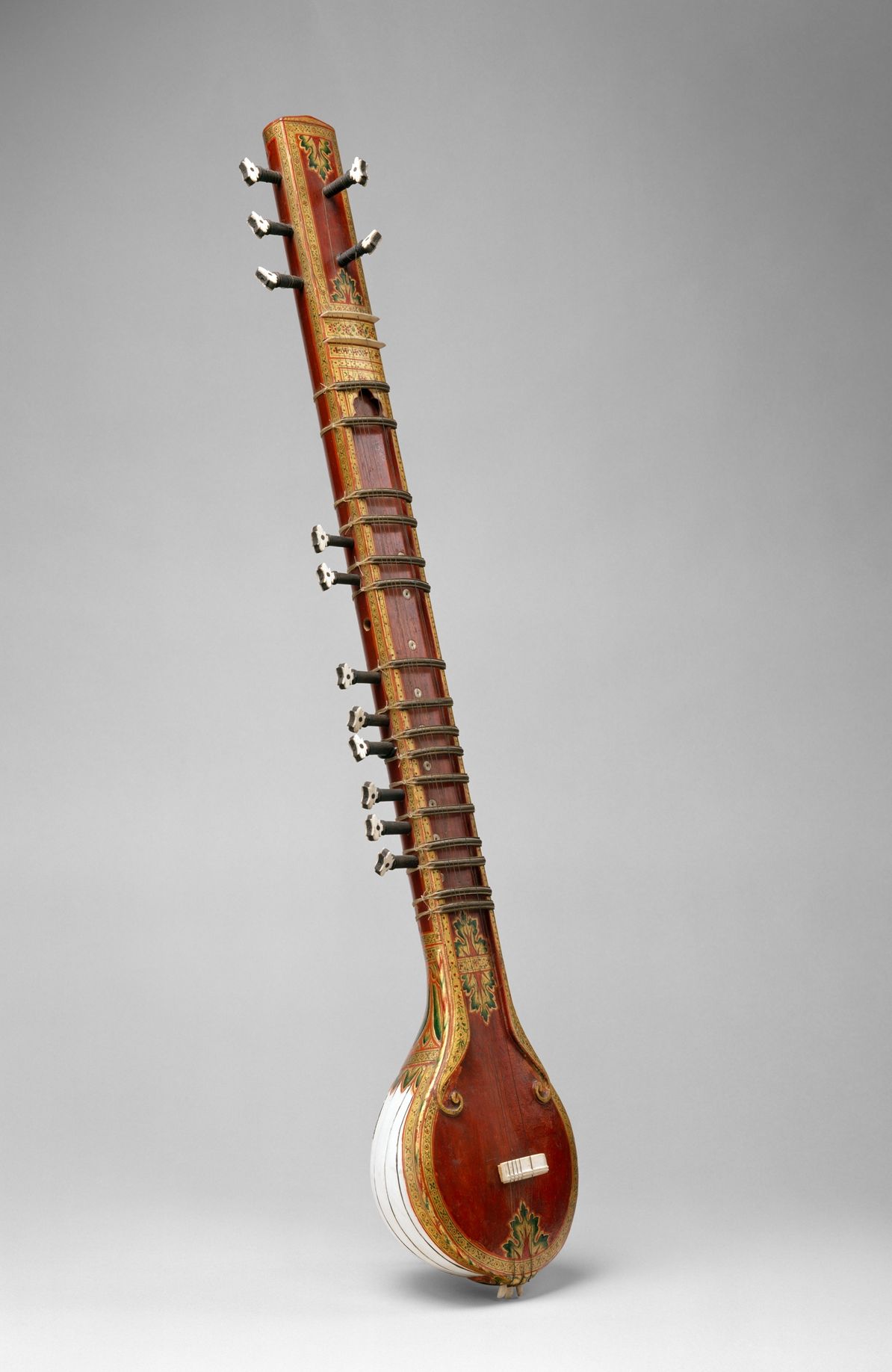
In performance, instruments also take on functional roles. A tanpura may sustain the drone; tabla or mridangam articulates and develops the rhythmic cycle; a sitar, sarod, veena, violin, bansuri or voice can carry the main melodic line; and instruments such as sarangi or violin may accompany a vocalist while also responding creatively to the unfolding raga. In folk and devotional settings, portable drums, cymbals, lutes, fiddles and wind instruments often connect music directly with procession, dance and communal participation.
From gramophone and cinema to streaming: modern listening worlds
Modern Indian music has grown through older traditions rather than replacing them. Recording technology, radio, cinema and later television transformed how music circulated, allowing voices and styles to travel far beyond their original performance settings. Film music became an especially influential multilingual arena in which classical ragas, folk melodies, devotional idioms, orchestral writing, jazz, rock, electronic production and international popular styles could meet. Light-classical forms, ghazal, bhajan, non-film songs and regional popular music also developed large audiences through recordings and broadcasting.
Digital platforms have widened this circulation again. A listener can move in minutes from a dhrupad recital to a Carnatic kriti, a Baul song, a regional wedding repertoire, an old film recording or an independent electronic track. This accessibility creates new possibilities for discovery, but context still matters. Understanding the language, occasion, lineage, instrument, poetic form and performance setting can turn casual listening into a deeper encounter with India’s musical diversity.
A practical listening path
- Start with one regional tradition and notice the relationship between language, occasion, instruments and community.
- Listen to a Hindustani and a Carnatic performance side by side. Notice how each establishes the tonic, develops melodic material and interacts with rhythm.
- Choose one instrument family and compare how different instruments produce sustain, attack, resonance and ornament.
- Return to the notation table only after listening. The written swaras become much clearer when connected with actual phrasing and movement.
- Explore a devotional, folk or theatre tradition and ask what the music is doing socially: accompanying worship, dance, storytelling, work, celebration or collective memory.
- Finally, listen to a film or contemporary track and identify older elements that may have been reinterpreted: a raga phrase, folk rhythm, classical instrument, devotional text or regional vocal colour.