
Maps of India
Maps help readers understand how geography, trade routes, kingdoms, empires, regions, cities, coastlines, rivers, and administrative boundaries have been represented across time. The Maps section on India.co.in brings together map-related pages from the Legacy area so readers can move from broad historical context to specific map views.
This page is a guide to the map collection. It does not replace official geographic, administrative, survey, postal, defence, or legal boundary sources. For current boundaries, PIN-code data, official maps, or legal use, readers should verify information through authoritative official sources.
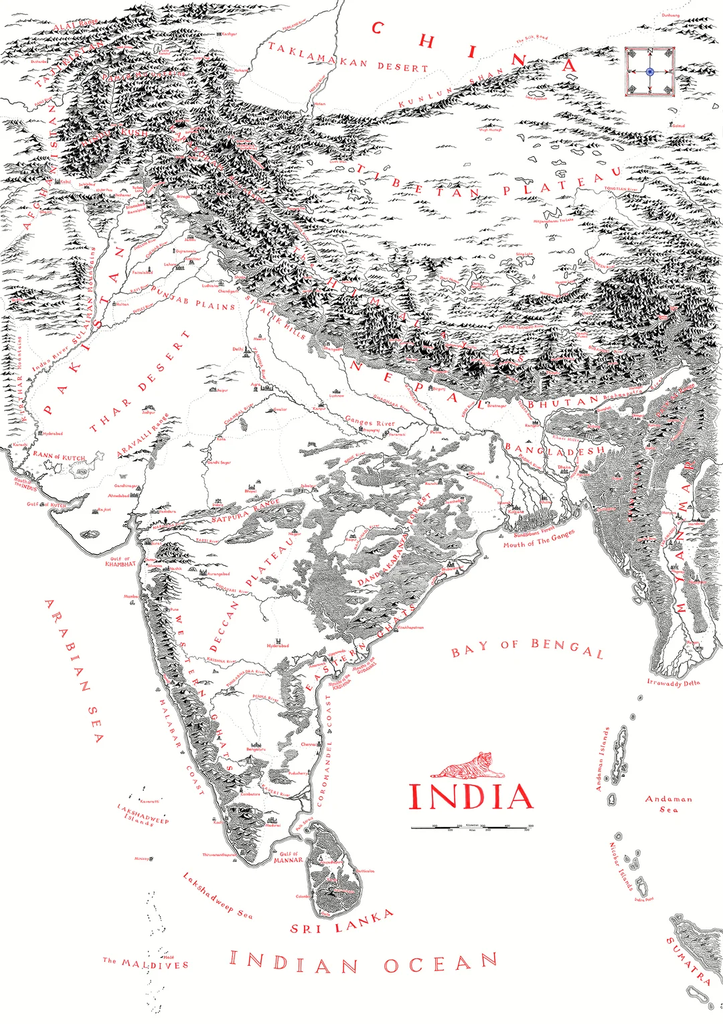
This map of India is a remarkable example of artistic cartography, combining geographic accuracy with visual storytelling. Rather than presenting India as a collection of political boundaries, it highlights the subcontinent’s defining physical features, allowing the Himalayas, river systems, plateaus, deserts, and coastlines to shape the viewer’s understanding of the landscape. The meticulous hand-drawn relief work gives the mountains a striking sense of texture and scale, while the restrained black-and-red color palette creates both elegance and clarity. By emphasizing terrain over administrative divisions, the map conveys India as a geographic and civilizational space, revealing how natural formations such as the Himalayas, the Ganges basin, the Deccan Plateau, and the surrounding seas have influenced movement, culture, trade, and history for centuries. The result is a map that is not only informative but also visually captivating, inviting viewers to explore India’s diversity through its geography.
Map collections in this section
Historical maps
Historical maps can be useful for understanding how India and surrounding regions were represented in different periods. They may show political boundaries, trade routes, regional names, colonial-era divisions, or broad geographic interpretations. Historical maps should be read with care because map-making reflects the knowledge, purpose, and political context of its time..
Start here:
- India Map – Historical
- India Map 1400s
- India Map 1500s
- India Map 1600s
- India Map 1700s
- India Map 1800s
- India Map 1900s
- India Map 2000s
Satellite and geological views
Satellite and geological map pages can help readers look at India through landforms, terrain, physical geography, mineral context, and broader environmental patterns. These pages should include source notes wherever images, datasets, or technical interpretations are used.
Suggested reading:
PIN-code and location reference maps
PIN-code maps are useful for understanding postal geography and location reference. Because postal boundaries and PIN-code details may change, any practical postal or delivery use should be checked through official postal sources.
Suggested reading:
How to read historical maps carefully
Historical maps should not always be treated as exact modern boundary records. A useful map page should explain:
- Approximate period or date range
- Source or map origin, where available
- What the map is showing
- Whether boundaries are historical, political, cultural, geographic, or illustrative
- How the page connects to related history articles
For current legal, administrative, or official use, readers should rely on current authoritative sources.
Suggested reading path
- Begin with History for broad historical context.
- Read Pre-Historic India or Vedic Period for period context.
- Open India Map – Historical to browse the historical map pages.
- Compare map periods carefully, noting that historical maps may reflect different political and cartographic viewpoints.
- Use Satellite Images or Geological for physical geography context.
Map topics at a glance
| Map type | Best use | Start here |
|---|---|---|
| Historical maps | Understanding period-wise representations | India Map – Historical |
| Century maps | Comparing broad historical periods | India Map 1500s |
| Satellite views | Physical and terrain context | Satellite Images |
| Geological maps | Landform and geological context | Geological |
| PIN-code map | Postal-location reference | Pin Code Map |
| History articles | Historical background | History |