
Growth Drivers of the Indian Economy
India’s economic growth is powered by a distinctive combination of scale, diversity and structural transformation. A large domestic market supports consumption, public and private investment expands productive capacity, and a broad economic base—spanning agriculture, manufacturing, construction, technology and modern services—creates multiple sources of momentum.
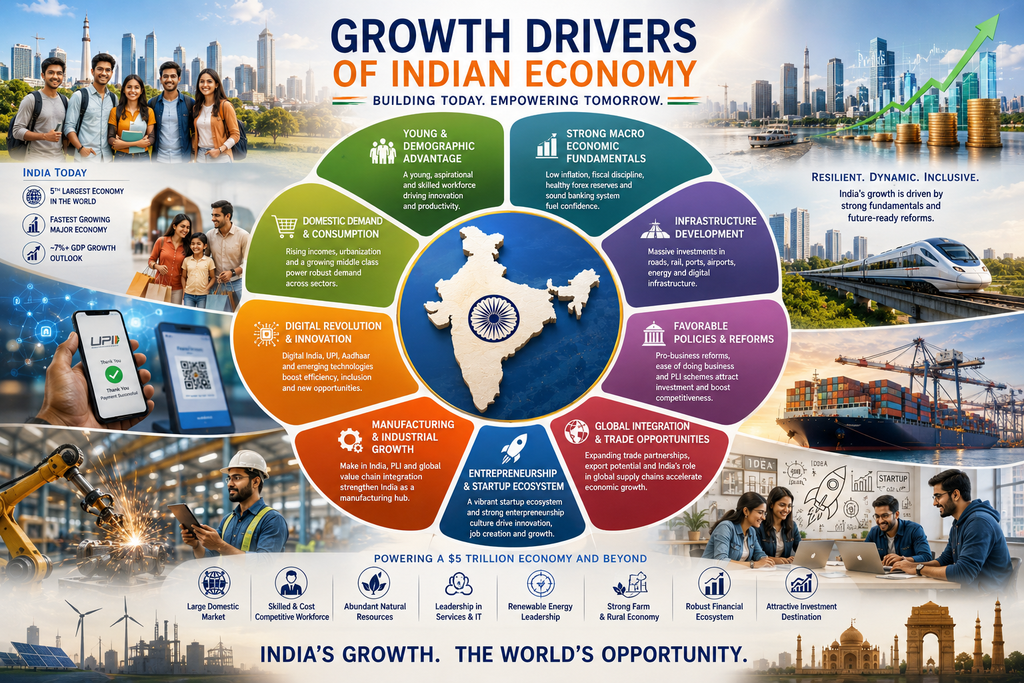
The country’s growth story is not dependent on a single industry or policy. It is shaped by the interaction of household incomes, infrastructure, entrepreneurship, digital adoption, financial access, industrial development, urbanisation, exports and improvements in institutional capacity. In FY 2025–26, official provisional estimates indicated that both private consumption and fixed capital formation grew by more than 7%, while several manufacturing and service activities recorded strong expansion.
Together, these forces are enabling India to produce more, connect markets more efficiently, attract investment and create new economic opportunities at home and abroad.
1. A large and expanding domestic market
India’s vast domestic market is one of its most important economic strengths. Demand is generated across metropolitan centres, emerging cities, small towns and rural communities, creating opportunities for businesses serving consumers at almost every income level.
Households spend on food, housing, transport, healthcare, education, communications, financial services, travel, entertainment and consumer products. As incomes rise and access to formal credit and digital services improves, spending increasingly extends to higher-value goods and services.
Domestic demand also gives India a degree of resilience when international economic conditions weaken. Exports remain important, but businesses operating in India can also serve a large internal market rather than relying exclusively on overseas customers.
The strength of consumption, however, depends on employment, real income growth, inflation, household confidence and access to affordable finance. Broad-based income growth therefore remains essential to sustaining demand.
2. A young population and expanding workforce
India’s demographic scale provides the economy with a large workforce and an extensive consumer base. A young and increasingly aspirational population can support economic growth through higher participation in employment, entrepreneurship, consumption and technological adoption.
This demographic advantage is not automatic. Its economic value depends on education, healthcare, employable skills, labour mobility and the availability of productive work. When workers acquire capabilities suited to modern manufacturing, services, logistics, healthcare, construction, digital platforms and emerging technologies, the demographic dividend can translate into higher productivity.
India’s long-term growth will therefore depend not only on how many people enter the workforce, but also on the quality of the opportunities available to them.
3. Household consumption and rising aspirations
Private consumption is a central component of India’s economy. Every increase in household demand creates activity across supply chains—from agriculture and manufacturing to retail, transport, telecommunications and financial services.
Consumption patterns are also becoming more diverse. Urbanisation, growing digital access and changing lifestyles are expanding demand for:
- Better housing and urban services
- Personal mobility and public transport
- Healthcare and education
- Banking, insurance and investments
- Smartphones, data and digital entertainment
- Travel, hospitality and recreation
- Branded food and consumer products
- Energy-efficient appliances and vehicles
Rural consumption is equally important. Agricultural incomes, government programmes, infrastructure access, remittances and the expansion of non-farm employment all influence purchasing power outside major cities.
The durability of consumption-led growth ultimately depends on stable prices, rising productivity and improvements in the quality of employment.
4. Investment and capital formation
Investment creates the productive assets that allow an economy to grow over time. Factories, machinery, power systems, warehouses, housing, transport corridors, digital networks and commercial facilities increase the country’s capacity to produce and deliver goods and services.
Gross Fixed Capital Formation, commonly known as GFCF, is therefore an important measure of economic momentum. It reflects investment in fixed assets that can support future output and productivity. Official estimates for FY 2025–26 indicated continued growth in fixed capital formation, reinforcing its role as a major demand-side driver.
Public investment often lays the foundation by improving infrastructure and connectivity. Private investment tends to accelerate when businesses see:
- Sustained market demand
- Predictable policies and regulation
- Reliable electricity and logistics
- Skilled labour and suitable land
- Access to finance
- Competitive input costs
- Opportunities to serve domestic and export markets
For small businesses, investment may involve a new machine, delivery vehicle, software platform, warehouse or production unit. For large enterprises, it may include an industrial facility, data centre, research complex or integrated supply chain.
5. Infrastructure development
Infrastructure is both an immediate source of economic activity and a foundation for future growth. Construction generates demand for steel, cement, machinery, equipment, engineering, finance and labour. Once completed, infrastructure lowers costs and improves the movement of people, goods, energy and information.
India’s infrastructure expansion includes:
- National highways and economic corridors
- Railway modernisation and freight capacity
- Metro and rapid-transit systems
- Airports and regional air connectivity
- Ports, waterways and logistics facilities
- Electricity generation and transmission
- Telecommunications and broadband networks
- Urban housing, sanitation and water systems
- Industrial parks and freight corridors
Better infrastructure can connect producers to larger markets, reduce delivery times, improve export competitiveness and make previously underserved regions more attractive for investment.
The Economic Survey 2025–26 identifies investment and infrastructure as central to strengthening national connectivity, productive capacity and competitiveness.
6. Services as a major engine of growth
India has developed deep capabilities across a wide range of service industries. Information technology and business services are globally recognised strengths, but the services economy extends far beyond software.
Important service sectors include:
- Banking, insurance and financial services
- Information technology and digital platforms
- Telecommunications
- Trade, transport and logistics
- Tourism and hospitality
- Healthcare and education
- Real estate and professional services
- Media, entertainment and creative industries
- Research, consulting and engineering services
Services support growth by creating skilled employment, enabling commerce, financing investment and generating exports. They also improve the productivity of other sectors. Efficient banking, logistics, software, communications and professional services make it easier for farms, factories and small enterprises to operate at scale.
In FY 2025–26, official estimates reported strong growth in trade, transport, communications, financial, real-estate and professional-service activities.
7. Digital public infrastructure and financial inclusion
India’s digital transformation has reduced friction in payments, identity verification, government service delivery and access to formal finance.
Digital public infrastructure and mobile connectivity have helped individuals and businesses conduct transactions quickly, create verifiable financial records and participate in online markets. The expansion of digital payments, particularly the Unified Payments Interface, has transformed retail transactions and supported a more accessible and diverse payments ecosystem.
Digital systems can support growth by enabling:
- Instant and low-cost payments
- Direct delivery of public benefits
- Remote account opening and verification
- E-commerce and digital marketplaces
- Digital lending and insurance distribution
- Online tax and business compliance
- Greater transparency in commercial transactions
- Access to customers beyond local markets
These benefits are strongest when digital expansion is accompanied by cybersecurity, privacy safeguards, consumer protection, reliable networks and digital literacy.
8. Manufacturing and industrial development
Manufacturing plays an important role in diversifying India’s economy, strengthening supply chains and creating employment across skill levels.
India has established capabilities in industries such as:
- Automobiles and automotive components
- Pharmaceuticals and medical products
- Chemicals and petrochemicals
- Textiles and apparel
- Steel, cement and engineering goods
- Electronics and telecommunications equipment
- Defence and aerospace production
- Food processing
- Renewable-energy equipment
- Industrial machinery
The Make in India programme was established to promote investment, innovation, infrastructure and the development of India as a manufacturing, design and innovation hub.
Industrial growth can generate extensive multiplier effects. A major manufacturing facility creates demand for component suppliers, logistics providers, maintenance services, packaging, construction, training and local commerce.
To realise its full potential, manufacturing growth requires dependable logistics, consistent quality, globally recognised standards, affordable energy, skilled workers and integration between large companies and smaller suppliers.
9. Agriculture and the rural economy
Agriculture remains fundamental to India’s economy, food security and rural livelihoods. Its importance extends beyond crop production to horticulture, livestock, fisheries, food processing, agricultural equipment, storage, transport and rural services.
Productivity improvements can raise farm incomes while releasing labour and capital for higher-value economic activity. Key enablers include:
- Irrigation and water management
- Improved seeds and agricultural research
- Mechanisation and precision farming
- Storage and cold-chain infrastructure
- Better access to markets and information
- Farmer organisations and agricultural finance
- Food processing and value addition
- Crop diversification and climate resilience
Rural development also depends on growth outside agriculture. Construction, manufacturing, tourism, logistics, renewable energy and digital services can create supplementary sources of employment and income.
10. Entrepreneurship and the startup ecosystem
Entrepreneurship allows new ideas to become businesses, products and employment opportunities. India’s startup ecosystem spans fintech, enterprise software, e-commerce, biotechnology, space technology, mobility, education, healthcare, agriculture and clean energy.
Startups can challenge established business models, improve service delivery and develop solutions for markets that were previously difficult to reach. Digital infrastructure, a large user base and increasing availability of technical talent have helped entrepreneurs test and scale new products.
The wider entrepreneurial economy also includes millions of micro, small and medium enterprises. These businesses provide employment, serve local markets and participate in industrial and service-sector supply chains.
Their growth depends on access to credit, timely payments, technology, skills, market information and simplified compliance.
11. Financial-sector depth and access to capital
A well-functioning financial system channels household savings into productive investment. Banks, capital markets, non-bank lenders, insurers, pension funds and digital financial platforms all contribute to the movement of capital across the economy.
Financial development supports growth by helping:
- Households save, borrow and manage risk
- Small firms obtain working capital
- Companies finance expansion
- Infrastructure projects raise long-term funding
- Entrepreneurs access equity and venture capital
- Consumers make major purchases
- Exporters manage currency and payment risks
Financial inclusion expands the number of people who can participate in formal economic activity. At the same time, sustainable credit growth requires effective regulation, responsible lending and careful management of financial risk.
12. Reforms and improvements in the business environment
Policy and regulatory reforms influence how easily individuals and enterprises can invest, operate and expand.
Important areas include:
- Tax administration
- Insolvency and bankruptcy processes
- Business registration and licensing
- Foreign-investment rules
- Digital government services
- Competition and market regulation
- Labour and land administration
- Contract enforcement
- Customs and logistics procedures
The objective is not simply to reduce regulation, but to make regulation clearer, more predictable and more efficient. A credible business environment protects public interests while reducing unnecessary delays and uncertainty.
Competition among states to attract investment, improve infrastructure and simplify processes can also encourage innovation in governance.
13. Global trade and foreign investment
India’s integration with the global economy provides access to customers, technology, capital, expertise and international supply chains.
Exports of goods and services allow Indian businesses to reach markets beyond domestic demand. Foreign direct investment can bring long-term capital, production methods, research capabilities, supplier relationships and global distribution networks.
India’s strategic location connects it to markets across Asia, the Middle East, Africa and Europe. Its capabilities in technology, pharmaceuticals, engineering, professional services and manufacturing support a growing role in global commerce.
Global integration also creates exposure to external risks, including:
- Slower international demand
- Geopolitical tensions
- Tariffs and trade restrictions
- Currency volatility
- Energy and commodity-price shocks
- Shipping and supply-chain disruptions
A resilient growth strategy therefore combines openness to global opportunity with strong domestic capabilities and diversified supply chains.
14. Urbanisation and the rise of growth centres
India’s cities are major centres of production, consumption, innovation and employment. Metropolitan regions attract investment and talent, while tier-two and tier-three cities are becoming increasingly important locations for manufacturing, technology services, education, healthcare and logistics.
Well-managed urbanisation can raise productivity by bringing workers, businesses and infrastructure closer together. It can also create challenges involving housing, congestion, pollution, water, public transport and municipal capacity.
India’s next phase of growth will depend significantly on whether its cities become more productive, liveable, connected and environmentally sustainable.
15. Renewable energy and the green transition
India’s energy transition is creating new opportunities in solar power, wind energy, electric mobility, green hydrogen, energy storage and efficient industrial technologies.
Renewable energy can support economic growth by improving energy security, reducing exposure to imported fuels and creating new manufacturing and service industries. It can also help Indian businesses respond to changing global environmental standards.
The transition must balance energy affordability, reliability, industrial competitiveness and environmental goals. Investment in grids, storage, domestic manufacturing and workforce capabilities will be critical.
How the growth drivers reinforce one another
India’s growth drivers operate as an interconnected system.
Infrastructure improves logistics and attracts investment. Investment expands production and employment. Employment supports income and consumption. Consumption encourages businesses to increase capacity. Digital platforms broaden markets and financial access. Skills raise productivity. Exports provide scale and foreign earnings. Public revenue allows further investment in infrastructure and human development.
This interaction creates a multiplier effect: progress in one area can strengthen several others.
| Growth driver | Contribution to the economy | Important watch points |
|---|---|---|
| Domestic consumption | Creates broad demand for goods and services | Inflation, household income and employment quality |
| Investment | Builds future production and infrastructure | Financing costs, execution and capacity utilisation |
| Infrastructure | Reduces logistics costs and connects markets | Project delays, maintenance and regional balance |
| Services | Supports jobs, exports and business productivity | Skills, global demand and employment intensity |
| Manufacturing | Develops supply chains, production and exports | Scale, quality, energy and logistics |
| Digital systems | Reduces transaction friction and expands access | Cybersecurity, privacy and inclusion |
| Agriculture | Supports food security and rural demand | Productivity, water, prices and climate risk |
| Entrepreneurship | Encourages innovation and job creation | Funding, regulation and business survival |
| Trade and FDI | Provides markets, capital and technology | Global growth, tariffs and geopolitical risk |
| Human capital | Improves productivity and innovation | Education quality, health and skill matching |