
Indian economy at a glance
India’s economy is one of the world’s most dynamic growth stories—powered by a vast domestic market, a young and skilled population, expanding digital infrastructure, world-class entrepreneurship, and a rapidly modernising industrial base. From agriculture, manufacturing and services to space technology, renewable energy, fintech, pharmaceuticals and advanced engineering, India combines scale with diversity in a way few economies can match. Supported by ongoing reforms, rising investment, stronger infrastructure and increasing global integration, the country is steadily transforming from an emerging market into a major economic, technological and manufacturing powerhouse, creating opportunities not only for its people but for businesses and investors across the world.
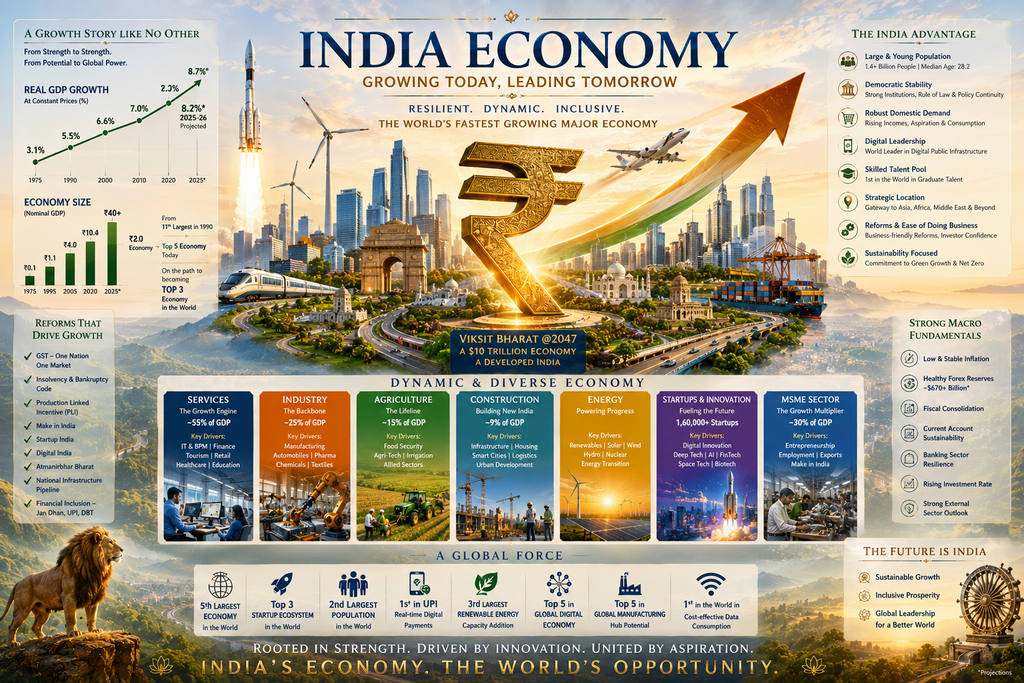
The scale of diversity and momentum of the Indian economy—from its strong agricultural foundations and expanding manufacturing base to its leadership in services, digital payments, infrastructure, renewable energy, space technology and entrepreneurship. The rising rupee, modern cities, transport networks, industries and innovation hubs symbolise an economy driven by a large domestic market, a young workforce, policy reforms and growing global influence. Together, these strengths position India as a resilient, future-focused economic power with the potential to shape global growth in the decades ahead.
Latest snapshot from official national accounts
| Metric | Latest cited figure | How to read it |
|---|---|---|
| Real GDP growth | 7.7% in FY 2025-26 | Growth after adjusting for inflation, using the latest MoSPI provisional estimate. |
| Nominal GDP growth | 8.9% in FY 2025-26 | Growth at current prices; useful for market size, tax base and rupee-value comparisons. |
| Real GDP level | ₹323.12 lakh crore in FY 2025-26 | Constant-price estimate, useful for comparing real output over time. |
| Nominal GDP level | ₹346.36 lakh crore in FY 2025-26 | Current-price estimate, useful for budgets, business size and revenue context. |
| Real GVA growth | 7.9% in FY 2025-26 | Shows growth in value added by sectors before net product taxes. |
| Base year | 2022-23 | The latest series mentioned by MoSPI; do not mix old-base and new-base figures casually. |
What makes the Indian economy broad-based
India is not a single-sector economy. Agriculture remains central for livelihoods and food security, but the largest share of output now comes from services such as finance, real estate, information technology, professional services, transport, communication, education, health, trade and public services. Manufacturing, construction, utilities and mining form the industrial side of the economy and are important for jobs, exports, infrastructure and urban development.
A useful way to understand India is to see three lenses together: production, demand and external connection. Production explains which sectors create value. Demand explains who buys goods and services: households, government, businesses and foreign customers. External connection explains exports, imports, remittances, foreign investment, technology partnerships and global supply chains.
Production lens
Look at primary, secondary and tertiary sectors, plus detailed activities such as manufacturing, construction, finance, trade and public services.
Demand lens
Private consumption and investment are central indicators because households and capital formation shape domestic economic momentum.
Global lens
Exports, imports and foreign investment show how India connects with supply chains, global services, energy markets and international capital.
Four pages in this economy section
This Indian Economy page is designed as the L3 hub under Opportunities. The three child pages below it go deeper into the structure of the economy. Read them in order if you are new to the topic, or jump directly to the page that fits your need.
| Page | Best for | What it explains |
|---|---|---|
| Sectors Of Indian Economy | Students, researchers, businesses | Primary, secondary and tertiary sectors, with a practical sector-by-sector view. |
| Growth Drivers Of Indian Economy | Businesses, policy readers, investors | Consumption, investment, infrastructure, services, manufacturing and productivity drivers. |
| Trade, Investment And Global Links | Foreign entities, exporters, diaspora readers | External trade, FDI, state-level investment and global linkages. |
| Related pages | Readers exploring opportunities | India Startups, Stock Exchange, PSUs and digital public infrastructure topics. |
Why India’s economy matters to different readers
For common readers, the economy affects prices, jobs, household income, public services, cities, transport and opportunities for the next generation. For small businesses, it determines demand, credit conditions, market size and formalisation. For foreign companies, India’s economy represents a large consumer market, a talent base, a services hub and a possible manufacturing and sourcing destination. For students, it is a practical case study in development, demographics, federalism, technology adoption and structural change.
No single statistic can describe this complexity. A high growth rate can coexist with uneven state-level development, sectoral differences, inflation pressure, skills gaps, infrastructure bottlenecks or global uncertainty. A balanced economy page should therefore combine data with interpretation and should not present any ranking or projection without a clear year and source.
Key terms explained simply
| Term | Meaning | Why it matters |
|---|---|---|
| GDP | Total value of final goods and services produced in the economy | Most common measure of economic size and growth. |
| GVA | Value added by producers before net product taxes | Useful for comparing sectors such as agriculture, industry and services. |
| Real growth | Growth after removing price effects | Better for understanding actual output growth. |
| Nominal growth | Growth at current prices | Useful for market size, revenue and fiscal comparisons. |
| GFCF | Gross Fixed Capital Formation | Measures investment in fixed assets such as buildings, machinery and infrastructure. |
| PFCE | Private Final Consumption Expenditure | Shows household consumption demand in the economy. |