
Doshas
In Ayurveda, Vata, Pitta and Kapha are the three doshas – traditional organizing principles used to describe patterns of movement, transformation, structure and balance in the body and mind. They belong to Ayurveda’s own conceptual system and should not be treated as measurable biomedical substances or as equivalents of modern anatomical or physiological categories.
Classical Ayurvedic theory describes health in terms of a dynamic relationship among doshas, body tissues, metabolic processes, waste elimination, mind, senses and environment. A person’s constitution and current state are interpreted through this broader framework by trained practitioners, rather than by assigning everyone to a single permanent ‘type’.
Traditional framework, not a biomedical diagnosis
Doshas are concepts within Ayurveda. They can be useful for understanding Ayurvedic theory and practice, but a dosha label is not a substitute for medical diagnosis, laboratory testing or evidence-based treatment when a health problem requires them.
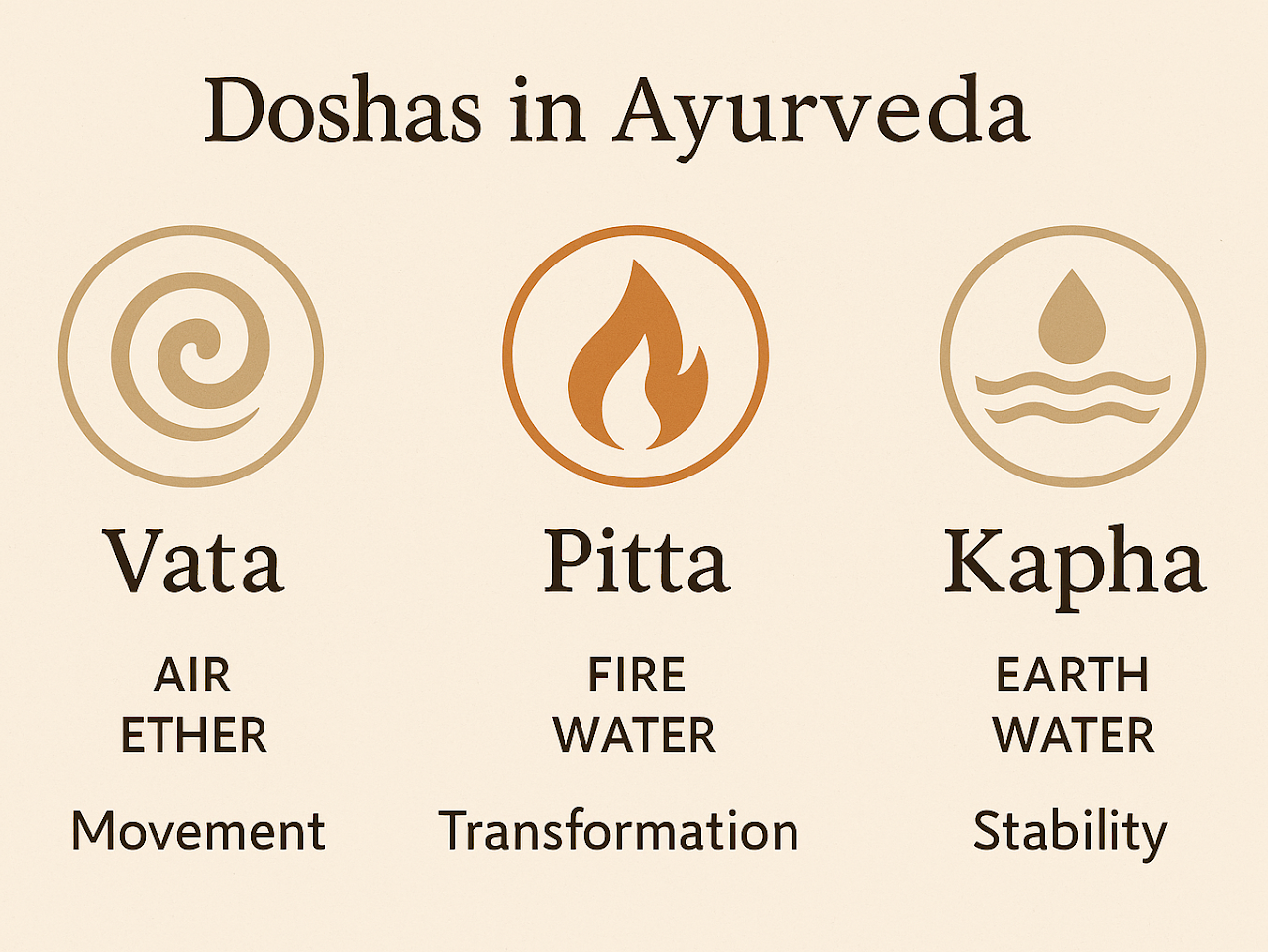
The three doshas in Ayurvedic theory
| Dosha | Traditional elemental emphasis | Traditional functional association |
|---|---|---|
| Vata | Space and air | Movement, circulation, respiration, sensory and nervous activity |
| Pitta | Fire with water | Transformation, digestion, metabolism and heat |
| Kapha | Water and earth | Structure, stability, lubrication and cohesion |
Vata
Vata is traditionally associated with movement. Ayurvedic texts connect it with motion in the body, including breathing, circulation, elimination, sensory activity and movement of thought. It is commonly described through qualities such as lightness, dryness, mobility and coolness. These are traditional descriptive qualities, not clinical measurements.
Pitta
Pitta is associated with transformation and heat. In Ayurvedic theory it is linked with digestion, metabolism, temperature and processes of discrimination or understanding. Fire is its dominant elemental association, with water also included in classical descriptions.
Kapha
Kapha is associated with structure, stability and cohesion. Traditional descriptions connect it with lubrication, bodily support, endurance and moisture. Water and earth are its dominant elemental associations, and its qualities are often described as heavy, cool, steady and smooth.
Balance, constitution and change
Ayurveda does not describe balance as having equal amounts of all three doshas. Instead, it interprets each person as having an individual constitutional pattern, while diet, season, age, activity, sleep, stress and other circumstances may be understood as shifting the current state. Ayurvedic practice aims to interpret those patterns in context and to choose individualized measures within the tradition.
Popular online quizzes often reduce this complex framework to a personality label. That can be misleading. A formal Ayurvedic assessment is broader and is intended to consider the person’s history, symptoms, habits and context. Self-identifying as Vata, Pitta or Kapha should therefore not be used to explain persistent symptoms or to decide whether medical care is necessary.
Diet and lifestyle in Ayurveda
Ayurvedic practice may use food, daily routines, exercise, sleep practices, massage, yoga, meditation and medicinal preparations as part of individualized care. Traditional recommendations are often described in relation to dosha patterns and season. However, specific ‘dosha-balancing’ diets or remedies should not be presented as universally proven treatments, because scientific evidence varies widely by intervention and condition.
Evidence and safety
Ayurveda is an established traditional medical system, but modern evidence for specific Ayurvedic treatments is uneven. The U.S. National Center for Complementary and Integrative Health notes that only a limited number of well-designed clinical trials are available for many Ayurvedic approaches. The World Health Organization likewise emphasizes evidence, quality, practitioner competence and safety when traditional medicine is integrated into health systems.
Ayurvedic products also require care. Some preparations have been found to contain potentially toxic levels of metals such as lead, mercury or arsenic. People who are pregnant, nursing, taking prescription medicines, managing chronic disease, or considering herbal or mineral preparations should discuss them with an appropriately qualified health professional. Ayurveda should not be used to postpone assessment of serious, persistent or worsening symptoms.
Understanding doshas responsibly
Doshas are most valuable as a way to understand the internal logic of Ayurveda: a traditional system that organizes observations of the body, behaviour, environment and change into a coherent framework. Appreciating that framework does not require confusing it with modern biomedicine. Keeping the two knowledge systems distinct makes it possible to discuss Ayurveda with both cultural respect and medical clarity.