
Decoration
Decoration in India is closely tied to craft, hospitality, ritual and celebration. Homes, places of worship, streets, shops and public venues are transformed for festivals, weddings and family ceremonies using flowers, lamps, textiles, painted motifs, paper, clay, metal, wood and stone. The result is not one national decorative style, but a wide family of regional practices shaped by local materials, religious traditions and artisan skills.
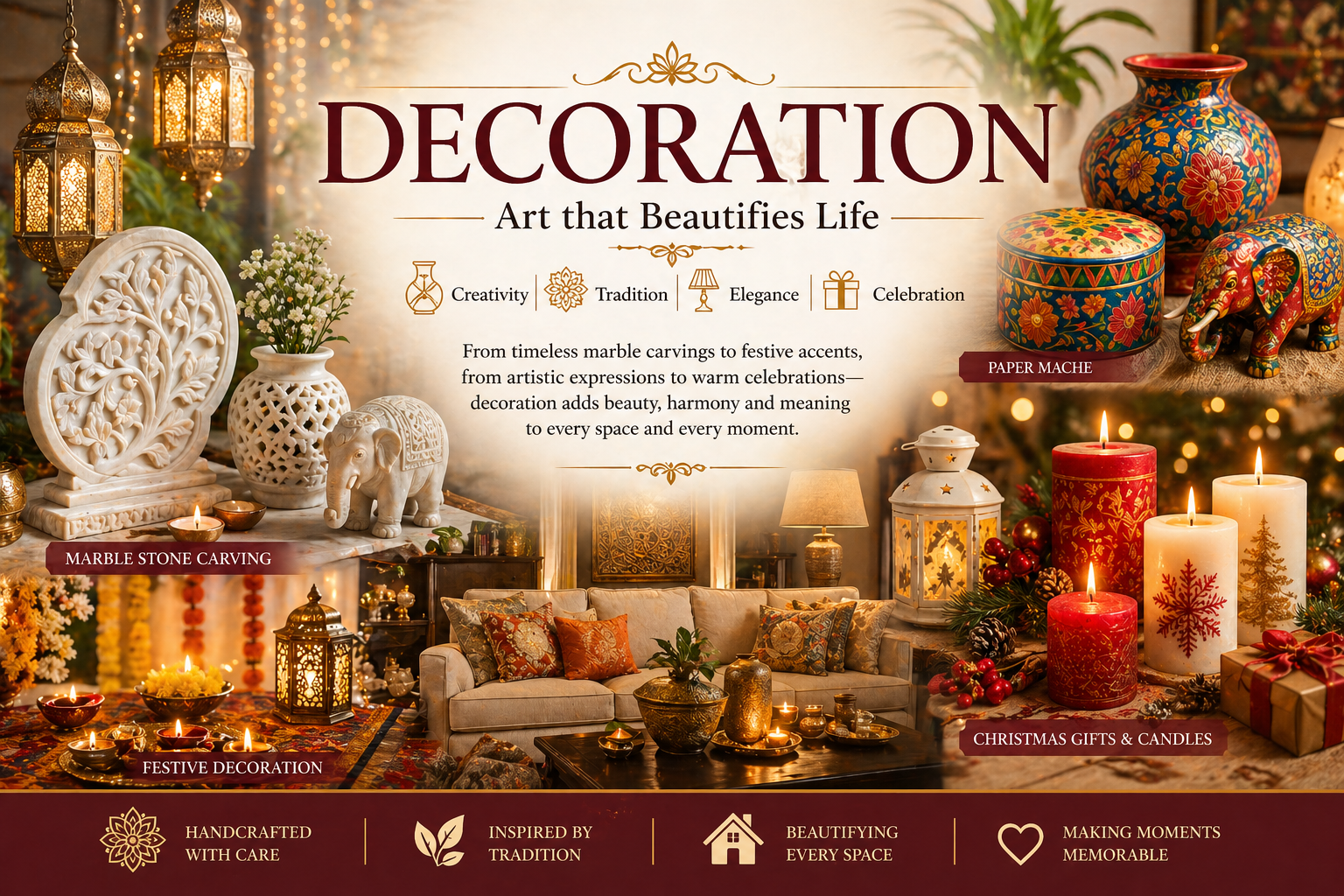
Decoration as a living craft tradition
Many decorative objects are also functional: lamps provide light, textiles divide or soften spaces, pottery stores or serves food, and carved stone forms part of architecture. In craft traditions, ornament is rarely separate from material. The colour of clay, grain of wood, translucence of stone, shine of metal or texture of handmade paper often becomes part of the design itself.
Contemporary artisans work across a broad spectrum. Some continue highly localized workshop traditions; others adapt inherited techniques for modern interiors, hospitality, gifts and export markets. Government handicrafts classifications include marble and stone crafts, paper work and papier-mache, terracotta and pottery, metalwork, textiles and many other categories used for decorative objects.
Marble carving and stone inlay
Stone carving has deep roots in Indian architecture and sculpture, while marble acquired particular prominence in several regions and historical periods. Rajasthan remains strongly associated with marble quarrying and carving, and Agra is renowned for marble inlay. Under Mughal patronage, the technique commonly known as parchin kari developed into highly refined floral and geometric decoration using pieces of coloured stone set into marble, famously visible in monuments such as the Taj Mahal and the tomb of Itimad-ud-Daulah.
Indian stone artisans work with white, black, green, red and other varieties of stone, selecting colour and natural veining as part of the composition. Decorative products can range from architectural panels and tabletops to boxes, plates, small sculptures and inlaid objects. Quality depends on the stone, precision of cutting and finishing, and the skill with which an artisan integrates the material's natural character into the design.
Papier-mache and painted paper craft
Papier-mache turns paper fibre into a light but formable material that can be moulded, dried, finished and painted. Kashmir is especially known for a distinctive papier-mache tradition in which objects such as boxes, ornaments and decorative vessels may be covered with finely painted floral, geometric or figurative designs. Paper-based craft also appears in many other regional and contemporary forms across India.
The appeal of papier-mache lies in the contrast between modest material and elaborate surface work. Recycled or pulped paper can become a durable base for hand painting, lacquer-like finishes and ornamental detail, making the craft suitable for lightweight decorative objects and festive pieces.
Terracotta: decoration shaped from earth
Terracotta and pottery are among the subcontinent's oldest material traditions. Clay has been used for vessels, lamps, toys, figurines, plaques, roof and architectural elements, ritual objects and sculpture. Because firing produces colours ranging from warm red and orange to brown or black depending on clay and technique, the material often needs little additional ornament to create a strong visual presence.
Regional terracotta traditions differ greatly in form and purpose. Some are closely connected to ritual or village life; others are produced for architecture, gardens and contemporary interiors. What connects them is the direct relationship between local earth, hand forming, firing and surface treatment.
Festive decoration across communities
Festival decoration changes with region and community. Diwali commonly brings rows of lamps, rangoli or other threshold designs, flowers and illuminated facades. Weddings may use marigolds, textiles, temporary structures and symbolic motifs. During Christmas, homes and churches in many parts of India use stars, cribs, candles, lanterns, greenery and lights. Other festivals create their own visual languages through flags, canopies, floral work, painted images, processional objects and temporary installations.
These practices show why decoration is more than surface embellishment. It can mark sacred time, welcome guests, identify a community, honour a deity or family event, and create a shared festive atmosphere. The objects may be temporary, but the skills and meanings behind them can be generations old.
Craft, continuity and change
Indian decorative arts continue to change as materials, markets and tastes evolve. Machine-made products now sit beside hand-crafted work, and artisans increasingly combine traditional techniques with contemporary forms. The most meaningful continuity lies not in freezing a style, but in sustaining the knowledge of materials, tools, motifs and processes that allows craft communities to keep designing for the present.