
Vedic Period
The Vedic Period is one of the formative eras of early Indian history, named after the Vedic corpus: a large body of sacred poetry, ritual formulas, prose explanations and philosophical reflection composed and preserved in Vedic Sanskrit. In conventional historical chronology, the period is placed broadly between about 1500 and 500 BCE, although the dating of individual texts and developments remains approximate and debated. Rather than a single, uniform civilization, the Vedic world changed substantially over these centuries as communities in northern South Asia moved from predominantly pastoral and clan-based settings toward more settled agriculture, larger political formations, increasingly elaborate ritual traditions and new forms of philosophical inquiry.
The period is especially important because it connects several long-term developments in the subcontinent: the composition and transmission of the Vedas, the growth of early Sanskrit intellectual traditions, the emergence of more complex social and political institutions, the expansion of agriculture into parts of the Indo-Gangetic plain, and the beginnings of ideas that would become central to later Hindu philosophical traditions. At the same time, the Vedic texts describe only parts of northern South Asia; many other regions of the subcontinent followed their own cultural trajectories and should not be treated as extensions of a single Vedic society.
The Vedic Period at a glance
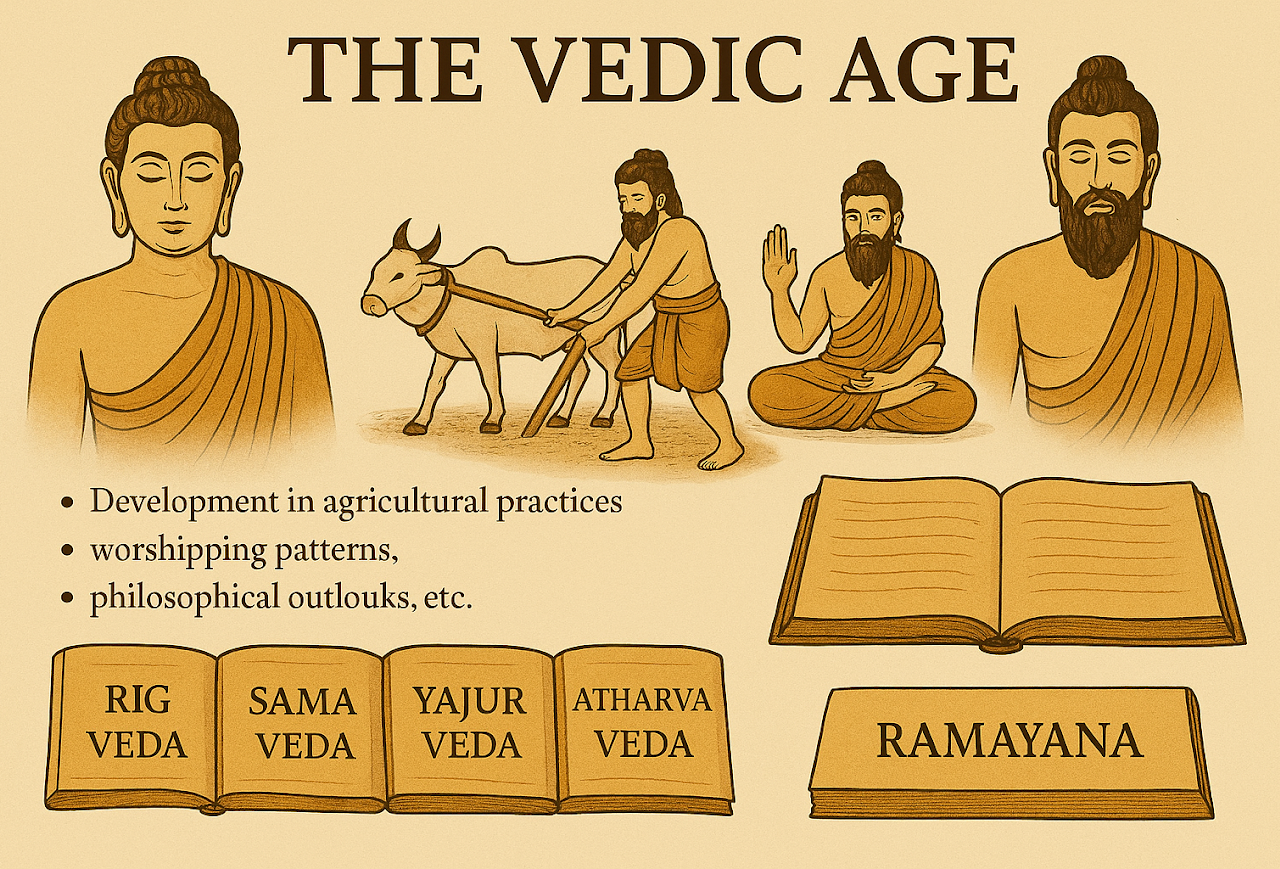
A useful historical framework divides the era into an Early or Rigvedic phase and a Later Vedic phase, while recognizing that boundaries between them are approximate rather than fixed.
- Approximate span: c. 1500-500 BCE in conventional historical chronology
- Core evidence: the Rigveda, other Vedic Samhitas, Brahmanas, Aranyakas and the earliest Upanishads, interpreted alongside archaeology and historical linguistics
- Geographic focus: initially the northwestern subcontinent, with later Vedic traditions increasingly associated with the upper Ganga-Yamuna region and adjoining areas
- Major transformations: pastoralism to more intensive agriculture, kin-based chiefdoms to territorial polities, simpler sacrificial practice to elaborate ritual systems, and growing philosophical speculation
Understanding the dates and the evidence
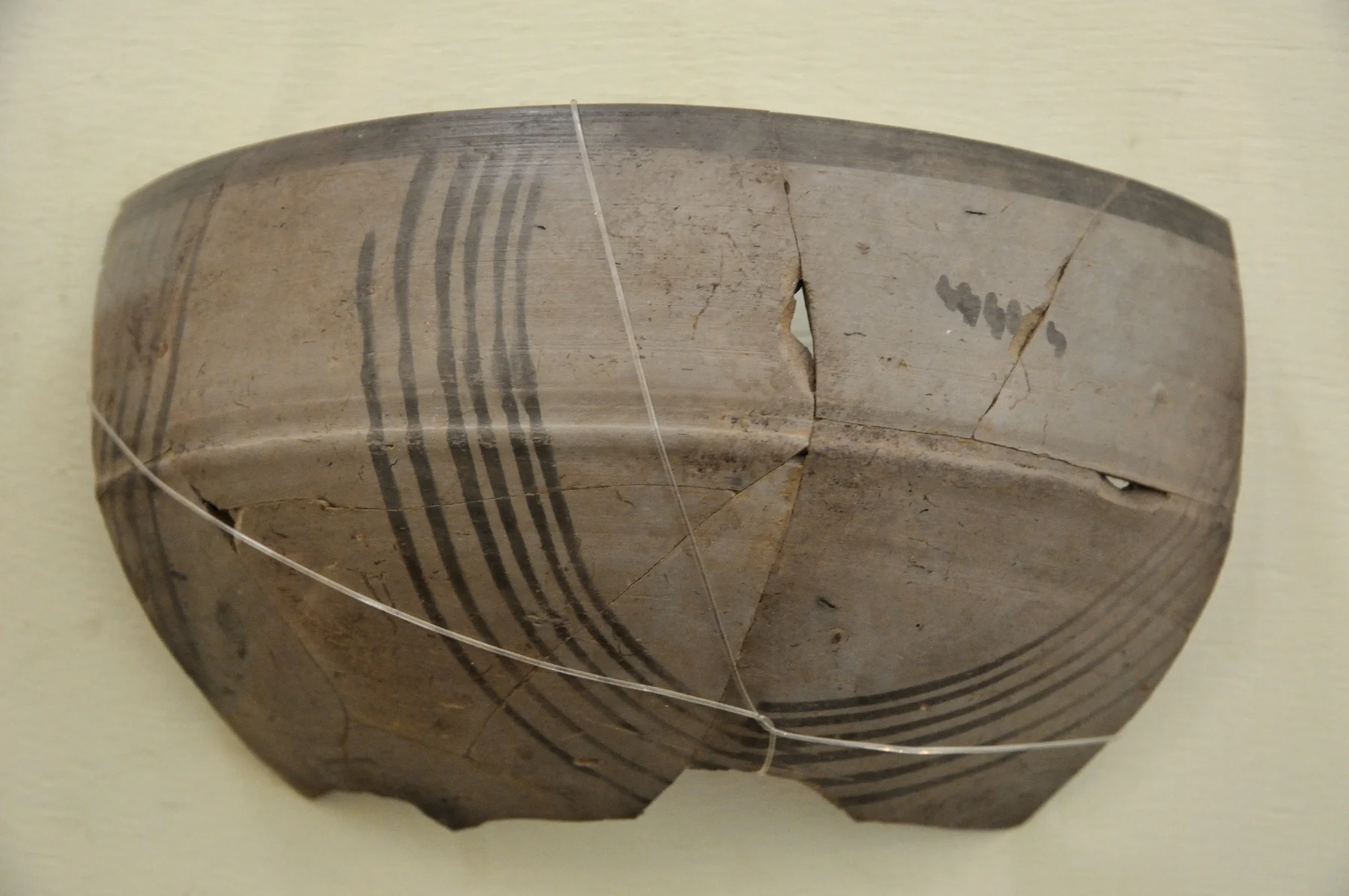
There is no single inscription, chronicle or archaeological layer that defines the beginning and end of the Vedic Period. Historians reconstruct it by combining several kinds of evidence. The Vedic texts are the richest literary source, but they were religious compositions rather than historical chronicles. They preserve references to rivers, cattle, agriculture, warfare, chiefs, assemblies, rituals, kinship and social distinctions, yet these references must be interpreted carefully and cannot be read as a complete census of everyday life. Archaeology adds evidence from settlements, ceramics, metals, crops and changing patterns of habitation, while historical linguistics helps place Vedic Sanskrit within the wider Indo-Iranian and Indo-European language families.
The origins and movements of Indo-Aryan-speaking populations have also been the subject of long-running public debate. Modern scholarship generally examines this question through converging linguistic, archaeological and genetic evidence rather than through the older image of a single, sudden ‘Aryan invasion’. Evidence supports population movements and interaction across Central and South Asia during the second millennium BCE, but the scale, routes, timing and relationship between demographic movement and cultural change remain subjects of research. It is therefore more accurate to describe the Vedic world as the result of long processes of migration, settlement, interaction and cultural transformation than as the product of one event.
Early and Later Vedic phases
The familiar division between Early and Later Vedic phases is a scholarly tool for understanding change across a long period. The Early Vedic phase is associated most closely with the hymns of the Rigveda and with communities centered in the northwest. The Later Vedic phase is reflected in the later Samhitas, Brahmanas, Aranyakas and early Upanishadic material, when textual geography and political organization increasingly point toward the western and central Gangetic region. The shift was gradual, uneven and regionally varied.
| Aspect | Early / Rigvedic phase | Later Vedic phase |
|---|---|---|
| Approximate chronology | c. 1500-1000 BCE | c. 1000-500/600 BCE |
| Principal textual evidence | Rigveda | Later Vedic Samhitas, Brahmanas, Aranyakas and early Upanishads |
| Main geographic emphasis | Northwest, including the Punjab and adjoining river systems | Upper Ganga-Yamuna region and territories farther east |
| Economy | Pastoralism important, with agriculture also present | Agriculture more prominent; larger and more settled agrarian communities |
| Political pattern | Kin-based groups and chieftaincies | Stronger kingship and increasingly territorial polities |
| Religious emphasis | Hymns, offerings and sacrifice centered on deities such as Indra, Agni and Soma | More elaborate sacrificial systems alongside growing speculation about ritual, cosmos, self and ultimate reality |
| Social organization | Status differences present but less formally articulated | Varna ideology becomes more explicit and social hierarchy more pronounced in the texts |
The geography of the Vedic world
The Rigveda evokes a landscape of rivers, grasslands, settlements and routes across the northwestern subcontinent. The Sindhu (Indus) and several of its tributaries are prominent, as are rivers remembered under names such as Sarasvati. This early textual geography is not a map of modern political boundaries, and the identification of some Vedic rivers remains debated. What is clearer is that the earliest Vedic material is strongly rooted in the northwest rather than across the whole of the Indian subcontinent.
Later Vedic literature reflects a growing focus on the region of Kurukshetra, the Ganga-Yamuna Doab and areas farther east. Communities such as the Kurus and Panchalas became especially important in later Vedic tradition. This eastward shift accompanied the spread of settled agriculture, the formation of larger political units and closer engagement with the fertile Gangetic plains. By the end of the period, the historical landscape was moving toward the age of the janapadas and mahajanapadas, when territorial states, towns, trade networks and new religious movements became increasingly visible.
The Vedas and the power of oral tradition
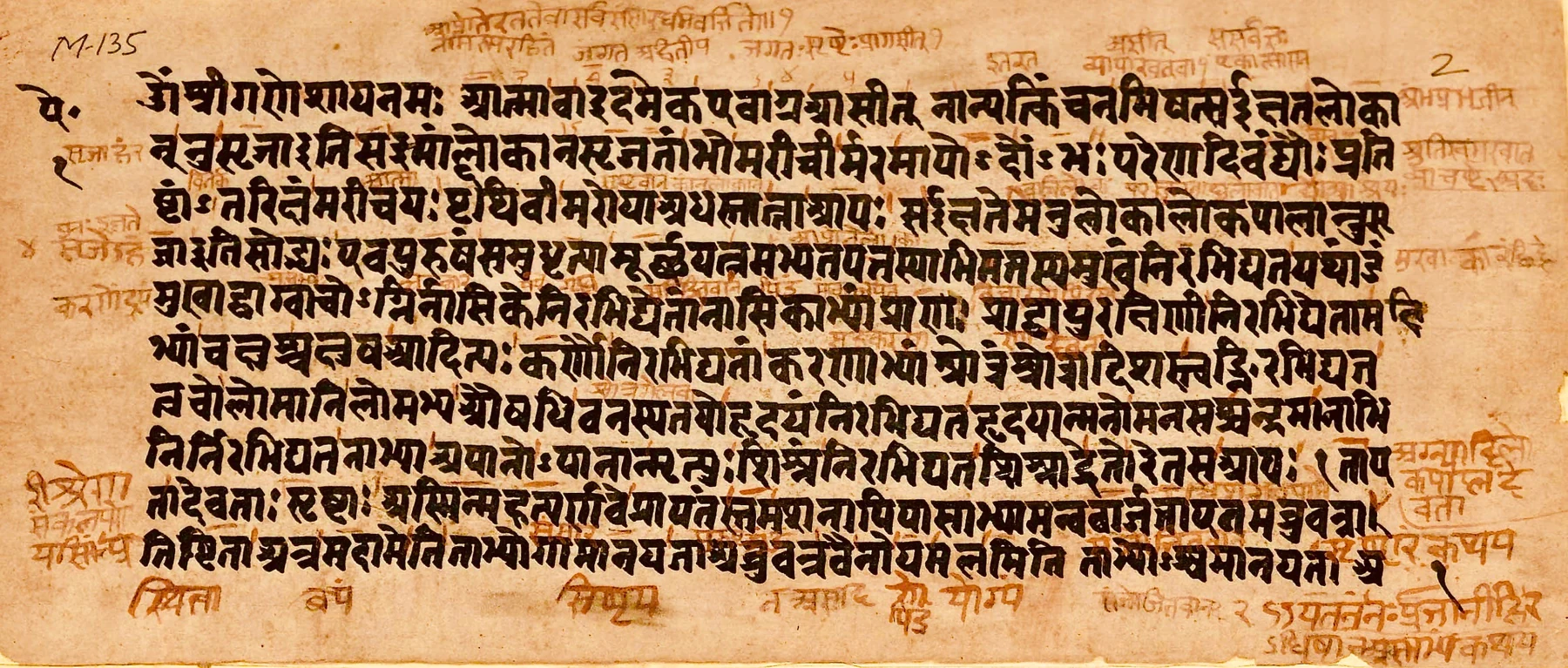
The word Veda is commonly understood as ‘knowledge’. The four Vedas are the Rigveda, Samaveda, Yajurveda and Atharvaveda. They are not four books written at one moment. Each belongs to a complex textual tradition transmitted through specialist lineages and schools. The Rigveda is the oldest surviving Vedic collection and consists primarily of hymns. The Samaveda reorganizes verses for melodic chanting in ritual performance. The Yajurveda preserves formulas and instructions connected with sacrifice, while the Atharvaveda contains prayers, charms, blessings, healing formulas and reflections concerned with a wider range of ritual and everyday concerns.
Vedic literature also includes prose texts known as Brahmanas, which explain the meaning and performance of sacrifice; Aranyakas, which often reinterpret ritual in more symbolic and contemplative ways; and Upanishadic material that explores questions about self, consciousness, death, knowledge and the underlying basis of reality. These layers overlap in time and purpose, so they should not be imagined as a perfectly neat sequence. Together they show an intellectual tradition expanding from praise and ritual performance toward increasingly abstract speculation.
One of the most remarkable features of the Vedic tradition is its oral preservation. For centuries, Vedic recitation was transmitted through highly disciplined methods of memorization, pronunciation, accent and patterned repetition. Different recitational techniques were designed to preserve not only the words but their sequence and sound with exceptional precision. Writing later became important for manuscripts and scholarship, but the authority of Vedic learning remained deeply connected with oral transmission.
Society, family and social differentiation
The household and kin group were fundamental units of Vedic society. Early texts suggest communities organized around families, clans and larger tribal groupings, with cattle, horses and other livestock carrying both economic and symbolic importance. Hospitality, gift exchange, feasting, ritual patronage and martial reputation appear repeatedly in the literature. Agriculture was already known in the Rigvedic world, but pastoral wealth had a particularly visible place in early hymns and social competition.
Social hierarchy became more explicit in later Vedic literature. The fourfold varna model of Brahmana, Kshatriya, Vaishya and Shudra acquired increasing ideological importance, although historians caution against assuming that this textual model operated everywhere in the same way. Varna should also not be treated as identical to the much more complex system of jatis and caste communities known from later Indian history. The Vedic period is better understood as a time when forms of status, occupation, ritual privilege and social ranking were developing and being articulated in new ways.
The position of women also varied across texts and contexts. Women appear in Vedic literature as householders, ritual participants and, in some hymns, speakers in philosophical or poetic dialogue. Later texts also reveal increasing patriarchal restrictions in several areas of social and ritual life. Broad claims that all women either enjoyed complete equality in the early period or uniformly lost all rights later oversimplify a much more complicated body of evidence.
Economy: from cattle wealth to expanding agriculture
Cattle were a major measure of wealth in the early Vedic texts. They were valued for dairy products, exchange, ritual gifting and social prestige, and conflicts over herds appear in the language of warfare and competition. Horses and chariots also carried high prestige, especially in martial and royal contexts. Yet the economy was never purely pastoral: references to cultivation, grain and ploughing show that farming formed part of subsistence from an early stage.
In the later Vedic period, agriculture became increasingly central as settlements expanded into the upper Gangetic plains. Rice appears more prominently in later sources, and heavier plough agriculture supported larger agrarian communities. Metalworking, carpentry, pottery, weaving, leatherwork, chariot-making and other specialized occupations are reflected in the texts. Iron use spread in northern India during the later part of this broad era, although its adoption was regional and gradual rather than a single technological revolution. Exchange still relied heavily on gifts, cattle and valued objects; monetized economies and large urban markets belong more clearly to the developments that accelerated toward and after the end of the Vedic Period.
Political life: from lineage leadership to territorial rule
The Rigvedic rajan is better understood as a chief or leader of a people than as the ruler of a fully developed territorial state. Authority depended on military success, alliances, ritual legitimacy, generosity and cooperation with other members of the community. Assemblies referred to by terms such as sabha, samiti and vidatha suggest that collective institutions played roles in political, social or ritual life, although the exact functions of these bodies are not always clear from the texts.
Later Vedic society saw stronger hereditary kingship and the consolidation of larger political formations. The Kuru-Panchala region became a major center for the systematization of Vedic ritual and political authority. Royal consecration ceremonies and large sacrifices helped present kingship as a sacred institution, while tribute and the beginnings of more regular revenue supported a wider political apparatus. These developments did not yet amount everywhere to the mature states known from later centuries, but they mark a decisive movement from lineage-based organization toward territorial rule.
Religion, sacrifice and the idea of cosmic order
Early Vedic religion centered on relationships between human communities, divine powers and the ordered cosmos. Among the most prominent deities of the Rigveda are Indra, associated with martial power and storms; Agni, the sacred fire and mediator of sacrifice; Soma, both a ritual substance and a divinized power; and Varuna, associated with sovereignty and cosmic or moral order. Other important figures include Ushas, Surya, the Ashvins, Savitr, Vayu and many more. The prominence of individual deities changes from hymn to hymn, and Vedic religion cannot be reduced to a simple fixed pantheon.
Yajna, or sacrifice, was a central means of maintaining relationships between humans, gods and the cosmos. Offerings were placed in the sacred fire, accompanied by carefully recited formulas and chants. The concept of rta expressed an underlying order or regularity in the cosmos, ritual and moral life. In later Vedic tradition, sacrificial systems became increasingly elaborate, requiring specialized priests with distinct ritual roles and producing extensive reflection on the symbolic correspondences between altar, body, speech, time and universe.
From ritual explanation to philosophical inquiry
The later Vedic corpus contains an important intellectual shift. Ritual did not disappear; rather, thinkers increasingly asked what gave ritual its power and whether the outward act pointed toward deeper principles. The Aranyakas and early Upanishads explore correspondences between the individual and the cosmos and develop ideas around atman, the self, and brahman, the ultimate or foundational reality in several strands of thought. Questions about action, consequence, rebirth, knowledge and liberation also became increasingly significant in the intellectual world of the late first millennium BCE.
This was not a single philosophical system. The Upanishads preserve debates, dialogues, competing explanations and experimental lines of thought. Their importance lies precisely in this widening field of inquiry: ritual specialists and teachers began to investigate whether knowledge, insight and disciplined reflection could reveal truths that sacrifice alone could not exhaust. These discussions profoundly influenced later Vedanta and other schools of Indian philosophy.
Knowledge, language and specialized learning
The demands of preserving sacred speech encouraged highly sophisticated attention to sound, meter, grammar, etymology and correct recitation. Vedic ritual also required careful observation of time, seasonal cycles and calendrical regularities. In the later Vedic and immediately post-Vedic intellectual world, these interests were systematized through disciplines that came to be known as Vedangas, including phonetics, meter, grammar, etymology, ritual procedure and astronomy or calendrical calculation. The exact dating of individual works differs, but the intellectual habits behind them grew from the need to preserve and interpret the Vedic tradition.
The Vedic Period and the Indian epics
The Ramayana and Mahabharata are central works of Indian civilization, but they should not simply be described as texts written during the Vedic Period. Both epics developed through long processes of oral and literary composition, redaction and expansion extending across centuries, with much of their surviving form taking shape after the conventional end of the Vedic age. The Mahabharata preserves names, social memories and settings that overlap with later Vedic traditions, especially the Kuru world, but the epic as we know it is a much later and layered work. The Ramayana likewise belongs to the post-Vedic epic tradition even though its story is set in an ancient past.
This distinction matters because Vedic literature and epic literature served different purposes and emerged in different textual environments. The Vedas are classified as shruti, or ‘that which is heard’, in Hindu tradition, whereas the epics belong to the broad category of smriti, or ‘that which is remembered’. The epics are invaluable for understanding the development of Indian ethical, political, religious and literary thought, but they should be used with caution when reconstructing the earlier Rigvedic world.
The end of the Vedic Period and the rise of new states
By roughly the middle of the first millennium BCE, northern India was undergoing another major transformation. Larger territorial states, expanding trade, fortified settlements and towns became increasingly important. The mahajanapadas emerged as major political powers, and the Gangetic basin became a center of economic and urban growth. These changes form part of what historians often call the second urbanization of South Asia.
The same broad era also witnessed new religious and philosophical movements, including Buddhism, Jainism and other shramana traditions, alongside continuing and evolving Brahmanical traditions. Vedic ritualism did not simply end; it was reinterpreted, preserved and integrated into new social and philosophical frameworks. The boundary between ‘Vedic’ and ‘post-Vedic’ is therefore a historical convenience rather than an abrupt cultural break.
Why the Vedic Period matters
The Vedic Period matters not because it represents a finished model of later Indian civilization, but because it records a long era of transformation. Across its textual layers we can see changing forms of speech, ritual, economy, kingship, social hierarchy and philosophical reflection. Vedic Sanskrit became foundational to a vast intellectual tradition; Vedic ritual shaped later Brahmanical practice; and concepts explored in the Upanishads influenced Indian philosophy for millennia.
At the same time, a historically responsible view avoids turning the Vedic age into a single golden age, a uniform national civilization or a simple story of one people replacing another. The evidence points instead to diversity, interaction and gradual change across a large and culturally varied subcontinent. Seen in that way, the Vedic Period becomes more compelling: it is a window into how communities preserved sacred knowledge while adapting to new landscapes, technologies, political structures and intellectual questions.