
Colours
Colour is one of the most visible languages of Indian public and private life. It appears in clothing, food, architecture, religious imagery, flags, flowers, painted homes, festivals and ceremonial objects. Yet there is no single code in which every colour has one fixed meaning across India. Associations change with region, religion, community, occasion and historical period.
A colour may signal celebration in one setting and restraint in another. Red can be bridal and auspicious in many Hindu wedding traditions, while white is often associated with mourning in several Hindu communities even though it also represents peace and purity in other contexts. The richness of colour in India comes precisely from this layered, sometimes contradictory symbolism.
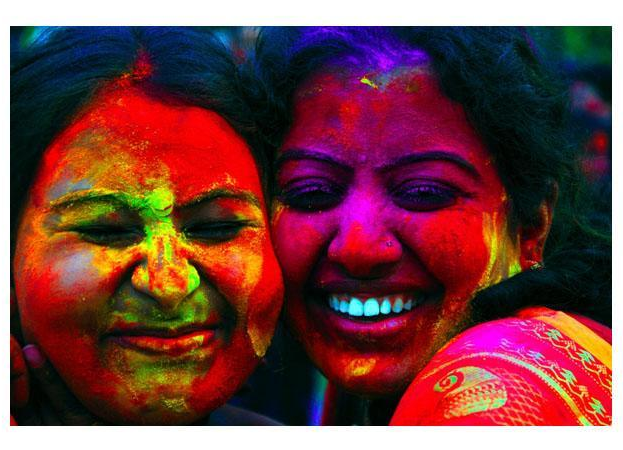
Holi: colour as celebration
Holi is among India's best-known celebrations of colour. Observed in different ways across regions, it is associated with spring, social gathering, play with coloured powders or water, and a variety of religious and local narratives. Its visual exuberance has made Holi a global shorthand for Indian colour, but it is only one part of a much wider cultural palette.
Colours and their changing meanings

Red: marriage, energy and auspiciousness
Red is strongly associated with weddings and auspicious occasions in many parts of India. Bridal clothing may use red, crimson or related shades, and sindoor – red vermilion worn by many married Hindu women – can mark marital status. These practices are widespread but not universal; wedding colours vary greatly by community and region.

Green: growth, nature and renewal
Green naturally evokes vegetation, harvest and renewal, so it appears readily in agricultural and springtime imagery. It also carries religious and community associations in particular traditions. As with other colours, meaning depends on context rather than on a single nationwide symbolism.
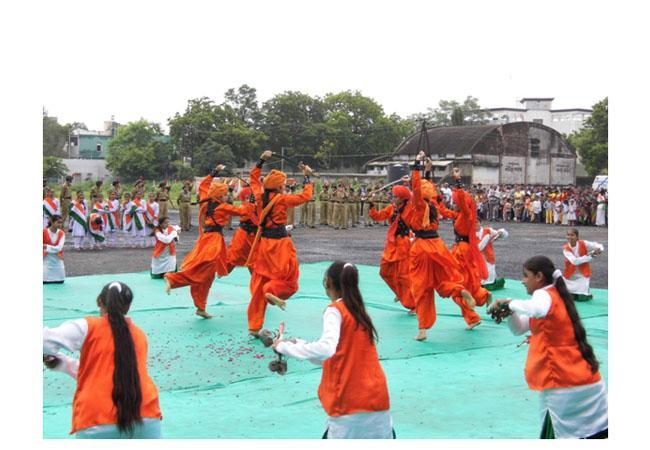
Saffron: courage, renunciation and sacred fire
Saffron has important religious and civic associations. In several Indian traditions it is connected with renunciation, spiritual discipline, sacrifice or sacred fire. In the National Flag, the Government of India describes the saffron band as indicating the country's strength and courage.

White: peace, simplicity and mourning
White can convey peace, truth, purity or simplicity, and the white band of India's National Flag officially represents peace and truth with the Dharma Chakra. In many Hindu communities, white is also associated with mourning and widowhood. Elsewhere it may be used for religious dress, summer clothing or celebration, showing how sharply context can change its meaning.

Blue: divinity, depth and public symbolism
Blue is prominent in Indian religious iconography, especially in representations of Krishna and Vishnu. It is also encountered in the deep blue of indigo textiles and in the peacock, India's national bird. The navy-blue Ashoka Chakra at the centre of the National Flag carries a distinct constitutional and civic symbolism.

Yellow: turmeric, spring and auspicious occasions
Yellow is closely associated with turmeric, a staple ingredient and a powerful visual symbol in many ceremonies. Pre-wedding haldi rituals in several communities use turmeric paste, while yellow clothing is linked with spring observances such as Basant or Vasant Panchami in parts of India. These associations are cultural and regional rather than universal rules.

Black: avoidance and protection
Black can be considered inauspicious in some ceremonial settings, yet it is also used protectively. Black thread, a small black mark or kajal may be used in some households in practices intended to avert the evil eye. The same colour can therefore express both caution and protection depending on custom.
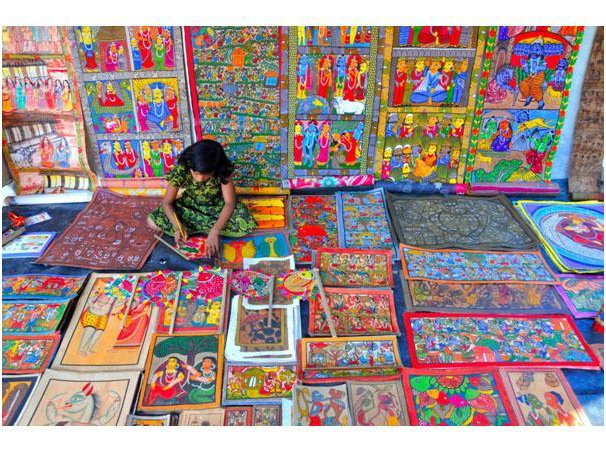
Many colours, many contexts
India's colour culture is most accurately understood as plural. Textile traditions, painted architecture, festival decoration, cinema, political movements and religious practice continually create new associations while older ones remain recognizable. Meaning comes from the combination of colour, object, setting and community.
The colours of the National Flag
The National Flag gives three colours an official civic meaning that should be distinguished from broader cultural symbolism. The top saffron band represents strength and courage; the white band represents peace and truth with the Dharma Chakra; and the green band represents the fertility, growth and auspiciousness of the land. At the centre is the navy-blue Ashoka Chakra with 24 spokes, based on the wheel shown on the Sarnath Lion Capital.
Reading colour with context
Colour symbolism is a useful doorway into Indian culture only when it is treated with care. Meanings vary across faiths, castes, regions, generations and occasions, and they continue to change through fashion, cinema, advertising and global exchange. Rather than asking what a colour 'means in India' in the abstract, it is usually more accurate to ask who is using it, where, and for what purpose.