
Sectors of Indian Economy
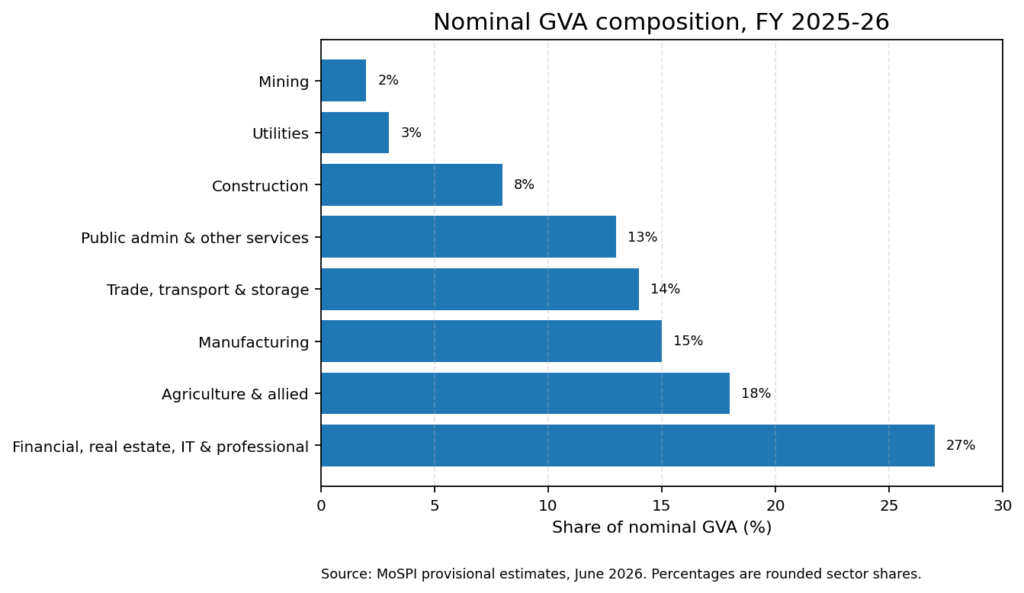
The sectors of the Indian economy explain where value is created. A farmer growing food, a construction company building a highway, a factory assembling electronics, a bank financing a business, a hospital delivering care and an IT company exporting services all contribute to the economy in different ways. This page explains the sector structure in practical language for students, families, businesses, investors and international readers.
Official national accounts group economic activity into detailed sectors. For simpler reading, they can be understood through three broad groups: the primary sector, the secondary sector and the tertiary sector. Each group has a different role in employment, income, productivity, exports, prices and regional development.
Primary sector: food, resources and rural livelihoods
The primary sector includes agriculture, livestock, forestry, fishing, mining and quarrying. Agriculture and allied activity are especially important because they connect directly with food security, rural income, monsoon conditions, irrigation, storage, procurement, food processing and household consumption. The sector may not be the largest by output share, but it supports a very large number of livelihoods and has strong social importance.
The performance of agriculture can vary because of rainfall, climate events, input prices, crop choices, market access, animal husbandry, fisheries and rural infrastructure. A good agricultural year can support rural demand, reduce food price pressure and improve confidence in many small towns. A weak year can affect food inflation, rural purchasing power and government policy priorities.
Secondary sector: manufacturing, construction and utilities
The secondary sector includes manufacturing, electricity, gas, water supply, other utility services and construction. Manufacturing matters because it can create supply chains, formal jobs, exports, supplier networks and technology learning. Construction matters because it connects directly with housing, roads, metro systems, ports, warehouses, factories, public works and urban expansion.
In the latest MoSPI provisional estimates for FY 2025-26, the secondary sector was one of the drivers of GVA growth. Within it, manufacturing showed strong growth and construction continued to be important for investment-led activity. For businesses, the secondary sector is closely linked to logistics, land, power supply, industrial corridors, labour skills, credit and compliance quality.
Tertiary sector: services, finance, trade and public activity
The tertiary sector is the largest part of India’s output. It includes trade, hotels, transport, communication, services related to broadcasting and storage, financial services, real estate, information technology, professional services, public administration, defence and other services such as education, health and personal services. This sector covers both highly formal activities and everyday services used by households and businesses.
India’s services strength is visible in IT and professional services, banking, insurance, digital payments, transport networks, telecom, online platforms and urban business services. At the same time, services are not only about big companies. Local shops, repair services, logistics operators, tourism businesses, coaching centres, hospitals and small professional firms are also part of the service economy.
Sector comparison
| Broad sector | Includes | Why it matters | What to watch |
|---|---|---|---|
| Primary | Agriculture, livestock, forestry, fishing, mining | Food security, rural livelihoods, raw materials | Monsoon, yields, prices, storage and rural incomes |
| Secondary | Manufacturing, utilities, construction | Jobs, infrastructure, supply chains and capital goods | Industrial output, power, credit, exports and capacity use |
| Tertiary | Trade, transport, finance, IT, public and other services | Largest output share, urban jobs and exportable services | Services demand, digital adoption, skills and formalisation |
| Cross-sector links | Food processing, logistics, e-commerce, tourism, construction materials | Sectors depend on each other | Input costs, policy, transport and market access |
How sectors connect in daily life
A packet of packaged food shows the links clearly. Farmers produce crops or milk. Transporters move goods. Food processors manufacture the product. Packaging suppliers provide material. Banks and digital payments support transactions. Shops and e-commerce platforms sell to consumers. Advertising, cold storage, warehousing and compliance services support the chain. A single product can therefore include primary, secondary and tertiary activity together.
A similar pattern appears in smartphones, housing, tourism, health care and education. This is why sector analysis should not be treated as isolated compartments. The real economy is connected through inputs, labour, credit, transport, technology and consumer demand.
Regional and business lens
Different Indian states and cities have different sector strengths. Some states are strong in manufacturing clusters, ports, auto components, electronics, textiles or chemicals. Others are strong in agriculture, tourism, mining, IT services, financial services, education or public administration. Businesses should therefore read national sector data together with state-level policies, infrastructure quality, workforce availability and local demand.
For students
Use sectors to understand GDP, employment, productivity and economic change over time.
For businesses
Use sectors to identify demand, suppliers, risks, input costs and regional opportunities.
For foreign readers
Use sectors to understand why India is simultaneously a farm economy, services hub and industrial market.
For a stronger reading of sector data, compare output share with employment, productivity, wages and regional concentration. A sector can be small in GDP share but still vital for livelihoods, prices or strategic capability.