
Trade, Investment And Global Links
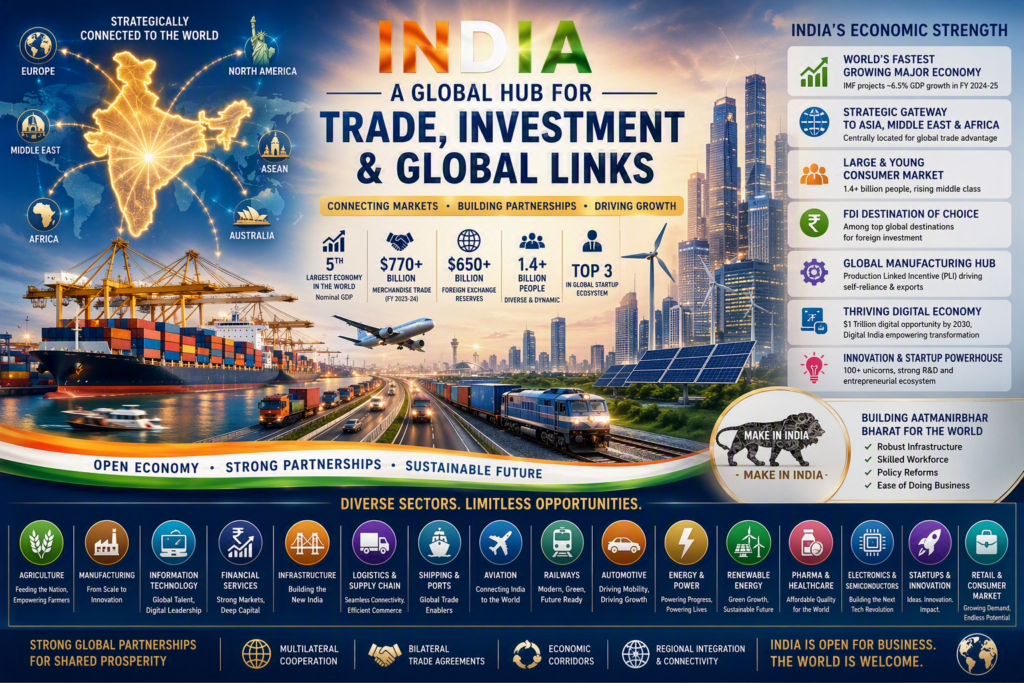
India’s economy is connected to the world through exports, imports, foreign direct investment, services contracts, technology partnerships, energy markets, remittances, capital flows and global supply chains. This page explains those global links in practical language for Indian businesses, students, diaspora readers and foreign entities evaluating India. It also helps readers understand market access and logistics.
Trade and investment should be read with balance. A rising export share can show competitiveness, but imports may also be essential for energy, electronics, machinery, fertiliser, raw materials and consumer goods. FDI can bring capital and technology, but its benefits depend on domestic linkages, skills, supplier development, policy clarity and long-term business confidence.
India in global trade
India exports both goods and services. Goods exports include areas such as petroleum products, engineering goods, pharmaceuticals, gems and jewellery, chemicals, textiles, agricultural products and manufactured items. Services exports include information technology, business services, professional services, travel, transport and financial services. The service-export story is especially important because it connects India’s skilled workforce with global demand.
According to the Economic Survey 2025-26 external-sector summary, India’s share of global merchandise exports nearly doubled from 1% in 2005 to 1.8% in 2024, while its share in global commercial services exports more than doubled from 2% to 4.3% over the same period. This shows that India’s global role is not limited to one category; both goods and services matter.
| Trade area | What it includes | Why it matters |
|---|---|---|
| Merchandise exports | Goods sold abroad | Supports manufacturing, agriculture, engineering and supply chains. |
| Services exports | IT, business, professional, travel and other services | Supports skilled employment and foreign exchange earnings. |
| Imports | Energy, electronics, machinery, raw materials and consumer goods | Supports production and consumption but affects trade balance. |
| Trade agreements | Bilateral and regional arrangements | Can affect market access, tariffs, standards and supply-chain decisions. |
| Logistics | Ports, roads, rail, warehouses and customs systems | Shapes export competitiveness and delivery reliability. |
Foreign direct investment
Foreign Direct Investment, or FDI, is long-term investment by foreign entities into businesses, projects or sectors in another country. It may involve capital, technology, management systems, market access and supplier relationships. For India, FDI is important because it can support manufacturing, services, infrastructure, financial activity, technology and employment when it connects with domestic capacity.
A DPIIT/PIB release reported India’s total FDI inflow at USD 81.04 billion in FY 2024-25, provisionally, up from USD 71.28 billion in FY 2023-24. The services sector led FDI equity inflows with 19%, followed by computer software and hardware at 16% and trading at 8%. Manufacturing FDI grew to USD 19.04 billion in FY 2024-25.
State and source-country pattern
FDI is not evenly spread. The same DPIIT/PIB release reported Maharashtra with the highest share of total FDI equity inflows in FY 2024-25 at 39%, followed by Karnataka at 13% and Delhi at 12%. Among source countries, Singapore led with 30%, followed by Mauritius at 17% and the United States at 11%. These figures show the role of state capacity, city ecosystems, financial networks and global investor relationships.
| FDI lens | FY 2024-25 snapshot | Interpretation |
|---|---|---|
| Total FDI inflow | USD 81.04 billion | Provisional headline inflow figure reported by DPIIT/PIB. |
| Top sector | Services, 19% of FDI equity | Shows continuing importance of services and urban business ecosystems. |
| Second sector | Computer software and hardware, 16% | Reflects technology and digital capability. |
| Top state | Maharashtra, 39% | Indicates concentration in major business and financial ecosystems. |
| Top source country | Singapore, 30% | Reflects regional investment routing and business linkages. |
What foreign companies should understand
Foreign companies should not treat India as a single uniform market. India is a union of states with different consumer profiles, languages, infrastructure quality, workforce clusters, local regulations, incentives and business cultures. A company entering India should study the relevant sector, state, city, logistics route, tax and compliance environment, talent pool and customer segment.
For smaller Indian businesses, global links can create opportunities through exports, supplier relationships, digital services, tourism, remittances, cross-border learning and imported technology. However, businesses must also watch currency movement, shipping cost, standards, quality certification, data rules, foreign competition and demand volatility.
Balanced view of opportunity and risk
Opportunity
Large market, skilled workforce, services strength, improving infrastructure, digital adoption and growing investor interest.
Risk
Global demand cycles, energy prices, trade barriers, currency shifts, logistics constraints and compliance complexity.
Practical approach
Use official sources, state-level research, sector experts and phased market testing before committing large capital.
How to read trade and investment news
- Check whether the number is for goods, services, total exports, FDI inflow or FDI equity inflow.
- Check the financial year and whether the data is provisional or revised.
- Separate headline inflow from actual job creation, domestic value addition and supplier development.
- Read state-level patterns because national data can hide regional concentration.
- Use official releases for facts and treat commentary as interpretation.