
Common Sports in India
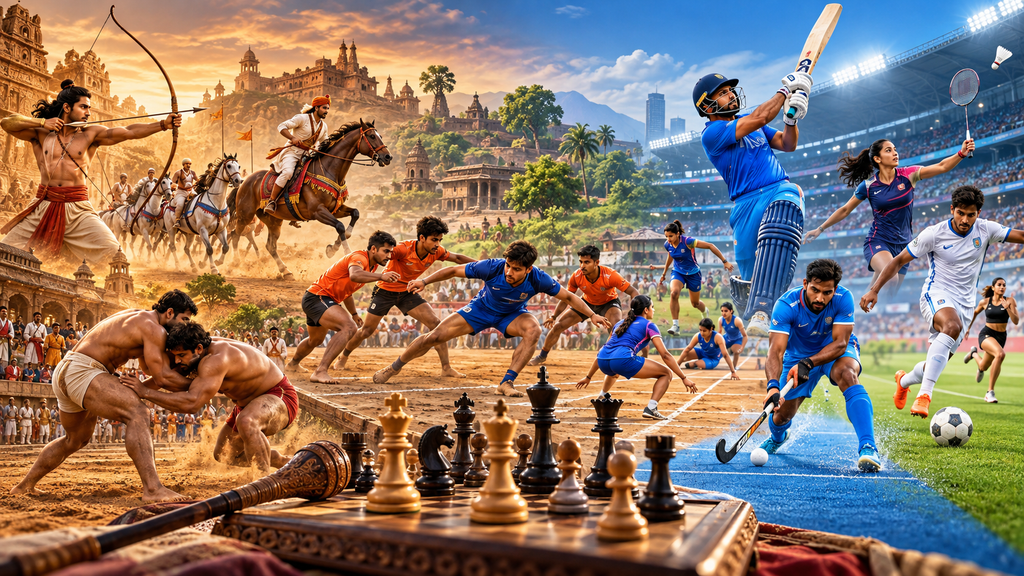
India’s sporting story is far older and more varied than the modern scoreboard. It stretches from Sanskrit epics that celebrate archery, wrestling, horsemanship, chariot skill and feats of strength, through village grounds, akharas and regional martial traditions, to packed cricket stadiums, professional leagues, global chess tables and Olympic arenas. Sport in India is not one tradition but many—ancient and modern, local and international, recreational and elite—coexisting across a vast and culturally diverse country.
For Indian readers, many of these games are part of living memory: something played at school, in a lane, on a maidan, in an academy or during a local festival. For international readers, Indian sport offers a wider story than cricket alone. It reveals a civilisation in which physical training, strategic games, martial skill, community competition and sporting spectacle have appeared in different forms for centuries, while modern India has enthusiastically embraced the global rules and institutions of contemporary sport.
Ancient-to-modern continuum
Government and educational sources describe archery, wrestling, horse-riding, chariot-racing, strength training and other physical disciplines in India’s ancient and epic traditions.
More than cricket
Cricket has extraordinary visibility, but football, hockey, badminton, athletics, wrestling, boxing, shooting, archery, chess, kabaddi, kho-kho and many other sports have strong followings and participation.
India’s own sporting heritage
Chess is widely traced to chaturanga in India, while kabaddi, kho-kho, mallakhamb, kushti and several martial traditions remain important parts of India’s indigenous sporting culture.
No official national sport
India has not officially designated any sport as its National Game. Field hockey has a celebrated place in Indian sporting history, but it is not an officially declared national sport.
From epic arenas to modern stadiums
Few countries can tell a sporting story in which epic literature, martial training, community games and modern international competition sit so visibly beside one another. NITI Aayog notes that the Ramayana and Mahabharata contain references to archery, wrestling, horse-riding and chariot-racing, while Ministry of Youth Affairs and Sports material places chariot-racing, archery, horsemanship, wrestling, stone lifting and related disciplines within India’s early sporting history. These references do not mean that today’s codified sports existed unchanged in antiquity; rather, they show how deeply ideals of skill, strength, balance, endurance and competition are embedded in India’s cultural memory.
How to read the ancient story
The Ramayana and Mahabharata are foundational epics and cultural texts, not modern sports manuals or archaeological records. Their contests are often martial, ceremonial or narrative in purpose. They are best understood as evidence of the kinds of physical abilities, competitive ideals and warrior skills admired in the traditions that preserved these stories.
Sports and physical contests in the epics
The epics repeatedly connect excellence with disciplined training. In the Ramayana, Rama’s feat with the mighty bow of Shiva at Sita’s svayamvara is one of the best-known demonstrations of strength and archery-related skill. In the Mahabharata, archery is central to the education and reputation of warriors such as Arjuna and Karna; the contest at Draupadi’s svayamvara turns precision with the bow into a public test of mastery.
Wrestling and close combat are equally prominent. The Mahabharata contains the celebrated wrestling encounter between Bhima and Jarasandha and the climactic mace combat between Bhima and Duryodhana. CBSE material on Indian martial traditions describes mallayuddha (wrestling) as sport, pastime and method of warfare, and also records dhanurvidya (archery), horse-riding, armed training and use of the gada or mace. In this older world, the boundary between sport, martial education and public spectacle was often much less distinct than it is today.
| Ancient or epic-era discipline | Cultural or literary context | Modern connection |
|---|---|---|
| Dhanurvidya / archery | A highly valued martial skill in the epics; famous tests of bow skill appear in both the Ramayana and Mahabharata | Modern competitive archery preserves the precision, concentration and technical mastery of the bow, although its rules and equipment are modern |
| Mallayuddha / wrestling | Wrestling bouts and renowned wrestlers appear in ancient literature, including Bhima’s contests in the Mahabharata | Kushti/akhara traditions and modern freestyle or Greco-Roman wrestling continue India’s strong wrestling culture in different forms |
| Gada-yuddha / mace combat | The gada is associated with strength and martial contest; the Bhima–Duryodhana duel is a famous Mahabharata episode | Primarily a martial and cultural heritage today rather than a mainstream codified modern sport |
| Horsemanship | Horse-riding and mounted combat are repeatedly associated with warrior training | Modern equestrian sport uses very different competitive formats but continues the tradition of rider control, balance and skill |
| Chariot skill and racing | Chariots are central to epic warfare, and government sport-history material also lists chariot-racing among early outdoor activities | No direct modern equivalent is mainstream in India; its significance is chiefly historical and cultural |
| Strength and conditioning | Ancient training traditions describe exercises for strength, lifting, running and grip | Weightlifting, strength training, athletics and wrestling conditioning now use scientific modern methods |
| Swimming and water exercise | Swimming appears in educational histories of physical training and recreation | Swimming is now an organised competitive and recreational sport |
| Chaturanga | An ancient Indian strategy game whose name refers to the four divisions of an army | FIDE traces the early form of chess to chaturanga in India; chess is now a global mind sport |
The Mahabharata also famously includes a game of dice. That episode is culturally important, but dice is better understood as gaming or gambling rather than athletic sport. Including it in the broader history of play helps show that ancient Indian recreation ranged from physical contests to strategy and games of chance.
The sports most commonly played in India today
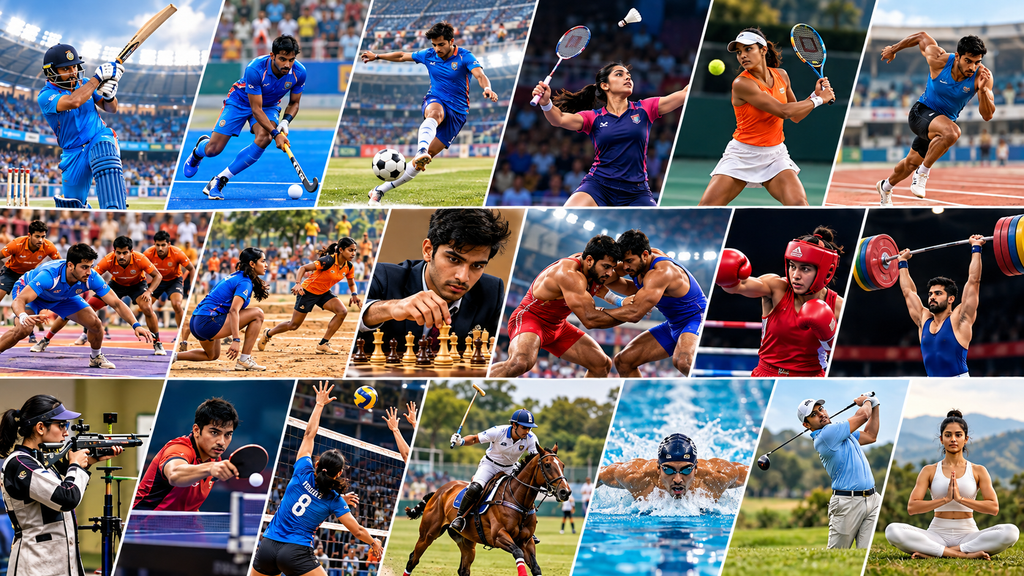
Modern India is both a participant in global sport and a country with its own highly distinctive sporting culture. What people play and follow varies greatly by region, age, facilities and local institutions, so there is no single definitive ranking. The table below is better read as a map of visibility and participation than as a league table of popularity.
| Sport or group | Place in Indian sporting life | Typical settings |
|---|---|---|
| Cricket | The country’s most visible spectator sport and one of its most widespread recreational games | Stadiums, clubs, academies, schools, maidans, parks, streets and informal spaces |
| Football | A major team sport with especially deep club and fan cultures in several regions | Fields, stadiums, schools, academies, community grounds and futsal spaces |
| Field hockey | A sport of exceptional historical prestige because of India’s Olympic legacy, with strong organised pathways | Turf facilities, schools, academies, clubs and institutional teams |
| Badminton | A widely accessible racket sport with strong recreational and elite participation | Indoor courts, schools, clubs, community halls and academies |
| Chess | A globally played mind sport with ancient Indian roots and a large contemporary competitive culture | Schools, clubs, academies, online platforms and tournaments |
| Kabaddi | An indigenous contact team sport that has become a modern professional spectator sport as well as a grassroots game | Schools, colleges, village grounds, clubs, academies and stadium events |
| Kho-kho | A fast indigenous team sport known for speed, evasion and tactical chasing | Schools, colleges, community grounds and organised tournaments |
| Athletics | Running, jumping and throwing disciplines fundamental to school and elite sport | Tracks, fields, schools, colleges, stadiums and training centres |
| Wrestling and boxing | Combat sports with strong grassroots traditions and established national and international pathways | Akharas, boxing halls, schools, academies and high-performance centres |
| Shooting and archery | Precision sports with established competitive pathways and specialised facilities | Ranges, academies, clubs and high-performance centres |
| Table tennis and tennis | Racket sports played recreationally and competitively | Schools, clubs, academies, residential complexes and sports centres |
| Volleyball and basketball | Common school, college and community team sports | School courts, colleges, clubs, institutions and community facilities |
| Weightlifting and strength sports | Competitive strength disciplines with formal coaching pathways | Gyms, training centres, academies and competitions |
Cricket — the great modern spectacle
Cricket is the most immediately recognisable face of Indian sport for much of the world. It is played at every level, from international stadiums and professional competitions to school grounds and improvised neighbourhood pitches. The sport’s adaptability is part of its reach: formal cricket may require carefully prepared facilities, while a casual game can begin with a tennis ball, a bat and almost any safe open space.
The BCCI, founded in 1928, governs organised cricket in India, while domestic, age-group, women’s and international structures support a vast playing ecosystem. Yet cricket’s dominance in public attention should not obscure the breadth of Indian sport; some of the country’s most distinctive sporting identities are found beyond the cricket field.
Hockey and football — history, identity and regional passion
Field hockey occupies a place of honour in India’s sporting memory. Indian teams established an extraordinary Olympic legacy beginning in 1928, and the sport remains deeply associated with the country’s international sporting history. It is important, however, to separate that prestige from a common myth: the Government of India has not officially designated hockey—or any other discipline—as the national sport.
Football has a different kind of strength: powerful regional club cultures, school participation, community tournaments and professional competition. In parts of the country it is woven deeply into local identity, while elsewhere cricket or other sports receive more attention. That regional variety is one of the defining characteristics of sport in India.
Badminton, athletics, wrestling, boxing, shooting and archery
India’s modern sporting profile has broadened significantly across individual disciplines. Badminton, athletics, wrestling, boxing, shooting, archery and weightlifting all have structured coaching and competition pathways. Their growth also shows how older Indian associations with wrestling, archery, strength and disciplined physical training can coexist with fully modern international rules, sports science and high-performance systems.
Kabaddi and kho-kho — indigenous games on the modern stage
Kabaddi and kho-kho are among the clearest examples of traditional Indian games becoming modern organised sports. Both require relatively modest equipment, which helped them flourish in schools and community settings. Kabaddi combines raiding, tagging, holding and tactical defence; kho-kho turns chasing and evasion into a rapid team contest built on timing, agility and anticipation. Their contemporary formats are codified sports, not unchanged replicas of ancient games, but their Indian cultural roots remain central to their identity.
Sports and games with Indian roots
India’s contribution to world sport is not best understood as a competition over who ‘invented’ the most games. The more interesting story is one of continuity and transformation. Some activities can be traced to ancient India; others developed through regional traditions, royal patronage, village life, akhara culture or martial training; many were later standardised into modern competitive formats. Together they form one of the world’s richest landscapes of indigenous play and physical culture.
| Sport or tradition | Indian connection | What makes it distinctive |
|---|---|---|
| Chess / chaturanga | FIDE traces chess to the Indian game chaturanga, whose early form is associated with sixth-century India | A strategy game that travelled through Persia and beyond before evolving into modern international chess |
| Kabaddi | Widely treated as an indigenous Indian team game; modern rules formalised older regional forms | A raider enters the opposing half to score while defenders coordinate to stop the raid |
| Kho-kho | Traditional Indian chasing game developed into an organised competitive sport | Alternating chasers and runners create a fast contest of agility, positioning and tactical timing |
| Mallakhamb | Traditional Indian pole and rope discipline associated historically with physical training and wrestlers | Combines strength, balance, flexibility, controlled movement and gymnastic skill |
| Kushti / akhara wrestling | A living Indian wrestling culture shaped by older mallayuddha traditions and later influences | Training emphasises technique, conditioning, discipline and the distinctive culture of the akhara |
| Kalaripayattu | Martial tradition strongly associated with Kerala and supported under government indigenous-games promotion | Weapon and unarmed practice integrates agility, flexibility, coordination and combat technique |
| Gatka | Martial tradition associated with Punjab and Sikh martial culture | Fast weapon-based practice, especially with stick and sword forms, now also presented in competitive formats |
| Thang-Ta | Traditional martial art of Manipur, part of the wider Huyen Langlon tradition | Combines sword, spear and unarmed techniques with precise movement |
| Silambam | Tamil martial tradition with a long association with staff training | Known especially for rapid staff movement, footwork and weapon-control techniques |
| Gilli-danda | A long-standing local game played in many parts of the subcontinent under varying rules | A small tapered stick is struck with a longer stick, combining timing, striking and fielding |
| Lagori / seven stones | Traditional team game known by several regional names | One team rebuilds a stack of stones while the other fields and attempts to tag players with the ball |
| Langdi | Traditional running and tagging game often played in schools and communities | The chaser moves on one leg, making balance and agility central to the game |
| Atya-patya | Traditional Indian team game with an organised competition history | Attackers try to cross defended lanes without being tagged |
| Yogasana as competition | Draws on India’s much broader yoga tradition; modern Yogasana competition is a specialised sporting format | Judges evaluate controlled postures and presentation, while yoga itself extends far beyond competitive sport |
One country, many sporting cultures
India’s sporting geography is as varied as its languages and landscapes. A game with modest national television coverage may be a major part of everyday life in a particular state, district or community. Local schools, armed forces and police institutions, universities, clubs, religious and community organisations, weather, terrain and access to facilities all influence which sports become deeply rooted. The examples below are illustrative, not exclusive.
| Area or setting | Illustrative sporting associations | Why the picture varies |
|---|---|---|
| North and north-west India | Wrestling and akhara culture, kabaddi, hockey, athletics and cricket are prominent in many local sporting ecosystems | Rural traditions, institutional teams, schools, academies and state investment differ widely from place to place |
| Western and central India | Cricket, kabaddi, kho-kho and mallakhamb are among the visible traditions in different areas | Large cities, smaller towns and rural districts support very different sporting mixes |
| Southern India | Cricket, badminton, football in several pockets, athletics, chess, Kalaripayattu and Silambam all have important communities | The sporting culture of Kerala, Tamil Nadu, Karnataka, Telangana and Andhra Pradesh is not uniform |
| Eastern India | Football, athletics, archery, hockey, cricket and local physical traditions have strong bases in different states | Urban clubs, tribal communities, schools and institutional sports create varied pathways |
| North-east India | Football, boxing, weightlifting, archery and martial traditions such as Thang-Ta are highly visible in parts of the region | The eight states have distinct sporting histories and should not be treated as a single culture |
| Riverine and coastal communities | Swimming, rowing, boat races and water-based festival traditions appear in selected regions | Geography and local festival culture strongly shape participation |
Traditional games also change name and rules across regions. Lagori may be recognised as seven stones or by another local name; informal cricket can have dozens of neighbourhood variations; wrestling differs between traditional mud akharas and modern mat competition. This flexibility is a strength: Indian sport has often survived by adapting to available space, equipment and community custom.
Why Indian sport is interesting to the world
For a global audience, India is compelling because several sporting histories meet here. Cricket demonstrates the scale with which an imported modern sport can become indigenised and culturally transformed. Chess illustrates an Indian-origin game that travelled across cultures and returned as a global competitive sport. Hockey carries a storied Olympic legacy. Kabaddi and kho-kho show how local games can be formalised for national and international audiences. Martial traditions such as Kalaripayattu, Gatka, Thang-Ta and Silambam preserve regionally distinctive approaches to movement, weapons and physical discipline.
The result is a sporting culture that is neither purely ancient nor merely borrowed from abroad. India continuously absorbs, adapts, codifies and reinterprets sport. A visitor may encounter a cricket match beside a local kabaddi court, a modern wrestling academy near a traditional akhara, schoolchildren playing kho-kho, or competitive chess whose deepest lineage is traced back to chaturanga. That coexistence is one of the most distinctive features of Indian sport.
From grassroots play to elite competition
Modern sporting pathways usually begin locally: in schools, colleges, neighbourhood clubs, village grounds, district competitions or private academies. State associations and national federations connect athletes to larger competition structures, while the Sports Authority of India operates talent-development and high-performance programmes.
Khelo India adds a national framework for participation, infrastructure, talent identification and competition. Government programmes also make explicit space for rural, indigenous and tribal games. The Sports Authority of India identifies disciplines including Mallakhamb, Kalaripayattu, Gatka, Thang-Ta, Yogasana and Silambam for promotion, while akhara and Indigenous Games & Martial Arts pathways help connect traditional physical culture with structured coaching and competition.
- Schools and universities introduce young people to organised rules, coaching and competition.
- Community clubs, local grounds and private academies provide regular practice in both mainstream and traditional sports.
- District and state associations connect local competitors to state and national championships.
- National federations govern rules, championships, teams and international participation for recognised sports.
- Sports Authority of India centres support talent development and high-performance training across multiple disciplines.
- Khelo India programmes broaden opportunities for youth, women, universities, winter and para sport, as well as rural and indigenous traditions.
Choosing a sport to play in India
The best sport for a beginner is usually the one that is accessible, enjoyable and supported by a safe local environment. A nearby maidan may make athletics, football, cricket, kabaddi or kho-kho practical; an indoor hall may favour badminton or table tennis; specialised academies can open access to swimming, shooting, archery, gymnastics, martial arts and combat sports. Tradition can be an inspiration, but safe modern coaching should guide actual participation.
- Check whether a qualified coach, recognised club or reliable school programme is available nearby.
- Match the sport to the participant’s age, health, interest and physical readiness.
- Use appropriate protective equipment and safe facilities where the discipline requires them.
- For children, favour programmes that balance skill development, enjoyment and age-appropriate competition.
- Learn martial, weapons-based or apparatus-based disciplines only under experienced supervision.
Frequently asked questions
What is the national sport of India?
India does not have an officially designated national sport. The Government of India has explicitly stated that it has not accorded National Game status to any sports discipline. Field hockey has exceptional historical importance because of India’s Olympic record, but that is different from an official designation.
Which sports are mentioned in the Ramayana and Mahabharata?
Government and educational sources discussing the epics refer to activities such as archery, wrestling, horse-riding and chariot-racing. The Mahabharata also contains famous wrestling and mace-combat episodes, while archery is central to several public contests and warrior-training narratives. These references are best read as literary and cultural evidence of valued physical skills, not as proof that modern codified sports existed in exactly the same form.
Which sport clearly originated in India?
Chess has one of the clearest internationally recognised connections. FIDE states that chess originated in India and identifies chaturanga, associated with sixth-century India, as its early form. India also has many indigenous physical sports and martial traditions, although the exact antiquity of individual modern rule sets is often harder to establish.
Are kabaddi and kho-kho ancient sports?
Both have deep roots in Indian traditional game culture and are widely treated as indigenous sports. Their present competitive formats, however, are modern codifications. It is more accurate to say that today’s sports grew from older Indian traditions than to claim that every current rule has survived unchanged from antiquity.
What is mallayuddha?
Mallayuddha is a traditional Indian wrestling tradition described in historical and literary sources. Wrestling appears prominently in the Mahabharata, and later texts discuss wrestling arenas, training, diet and techniques. Modern Indian wrestling includes both international mat styles and living kushti or akhara traditions shaped by multiple historical influences.
What are some indigenous sports still practised in India?
Examples include kabaddi, kho-kho, mallakhamb, kushti, Kalaripayattu, Gatka, Thang-Ta, Silambam, gilli-danda, lagori, langdi and atya-patya. Their reach varies by region, and some are practised primarily as martial or cultural traditions while others have formal competitive federations and tournaments.
Is cricket the only sport that matters in India?
No. Cricket has unmatched mass visibility, but India’s sporting culture is much broader. Football, hockey, badminton, athletics, wrestling, boxing, shooting, archery, chess, table tennis, volleyball, basketball, kabaddi, kho-kho and many regional games all have substantial communities of players and followers.
Do all parts of India follow the same sports?
No. Sporting preferences vary sharply by region, city, district, school system, available facilities and local tradition. A sport that is dominant in one area may be secondary in another. India is best understood as a collection of overlapping sporting cultures rather than a single uniform market.
Sources and references
This overview uses official, educational and governing-body sources for claims that are frequently misstated, particularly India’s ancient sporting traditions, references in the epics, indigenous-sport promotion, the origin of chess and the question of a national sport. Historical traditions are described with deliberate caution where modern rules cannot be projected backwards with certainty.
Authoritative and institutional references
- NITI Aayog — Reinvigorating Sports in Rural Areas
- Ministry of Youth Affairs and Sports — Evolution of Modern Indian Sports
- CBSE — Martial Arts Traditions
- NIOS — Physical Education and Yog: historical development
- Sports Authority of India
- PIB — Promotion of rural and indigenous/tribal games
- FIDE — Game of Chess and its History
- PIB — Status of National Game to any sports
- BCCI — About BCCI
- All India Football Federation — History
- Hockey India — 100 years of Indian hockey