
Madurai
Popularly known as “Athens of East“, Madurai is the second largest city of Tamil Nadu. It is also one of the oldest continuously inhabited cities in India. Madurai is situated at the banks of River Vaigai in Madurai district. This city has numerous other names such as City of Four Junctions (Koodal Maanagar), Cultural Center of Tamil Nadu (Kalaachaara Thalainagar), City of Jasmine (Malligai Maanagar), Sleepless City (Thoonga Nagaram) and The City of Festivals (Thiruvizha nagaram). The city got its name from Sanskrit word “Mathura”, which means “sweetness”. Madurai has had a long and impressive history. Megasthenes referred this city in his book called Indica. After his visit in 3rd century B.C., many other Roman and Greek travelers visited Madurai and established trade with the Pandya Kings. Madurai remained the capital of Pandyas till 10th century when it is captured by the Cholas. Pandyas regained control of the city in 13th century, after which the city became prosperous again. Madurai played a significant role in the Indian independence movement. Post independence, the city expanded radically, and became an important city in the state of Tamil Nadu.
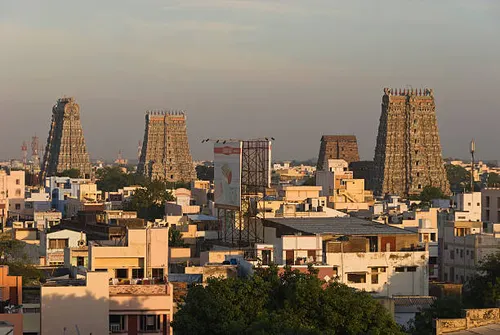
Madurai city is spread in an area of 109 square kilometers, with the average elevation being at 101 meters above sea level. The climate of Madurai is mostly hot and dry, with rainfall in the month of October, November and December. Topographically, Meenakshi Sundareswar Temple lies in the center of the city, with the whole city being built in shape of a lotus around it. The streets of Madurai are rectangular in shape and are named after Tamil months. The streets of Madurai are always bustling with people, day and night. Many small and big dining establishments like the small tea shops and roadside restaurants remain open well past midnight. What’s more, the transport system is also unique In Madurai as it remains functional 24 hours. This rightly proves as to why Madurai is popularly tagged as the ‘Sleepless City’. Automobiles, rubber, granite, IT, retail and electronics are important economic sectors in Madurai. Madurai is also the learning center of the region; the famous Madurai Kamraj University being situated here.
Madurai is also known as the ‘City of Temples’. The prestigious temples include Meenakshi-Sundareswar Temple, Thirupparankundram Temple, Koodal Azhagar Perumal Temple, Madhana Gopala Swamy Temple and Vandiyur Mariyamman temple. Meenakshi-Sundareswar Temple is one of the greatest Shiva temples in south and also one of the greatest cultural landmarks in the country. Thirumalai Nayakar Mahal is another famous tourist attraction in Madurai. It was built in year 1636 and is now a national monument. Gandhi Museum is another noteworthy place. Earlier popular as Rani Mangamma’s Palace, it was later renewed and converted into a museum. This museum holds the original blood stained garment wore by Mahatma Gandhi on the day of his assassination. There are many other famous tourist attractions and landmarks in Madurai. This list includes Kazimar Big Mosque (Periya pallivasal) and Maqbara, Thiruparankundram, Goripalayam Dargah, St. Mary’s Cathedral Church and Koodal Azhagar Koil. Madurai also has a water theme park, Athisayam, located at the outskirts of the city. Other places that are worth a visit in the city are the Rajaji Children Park, Eco Park and Hawa Valley.